
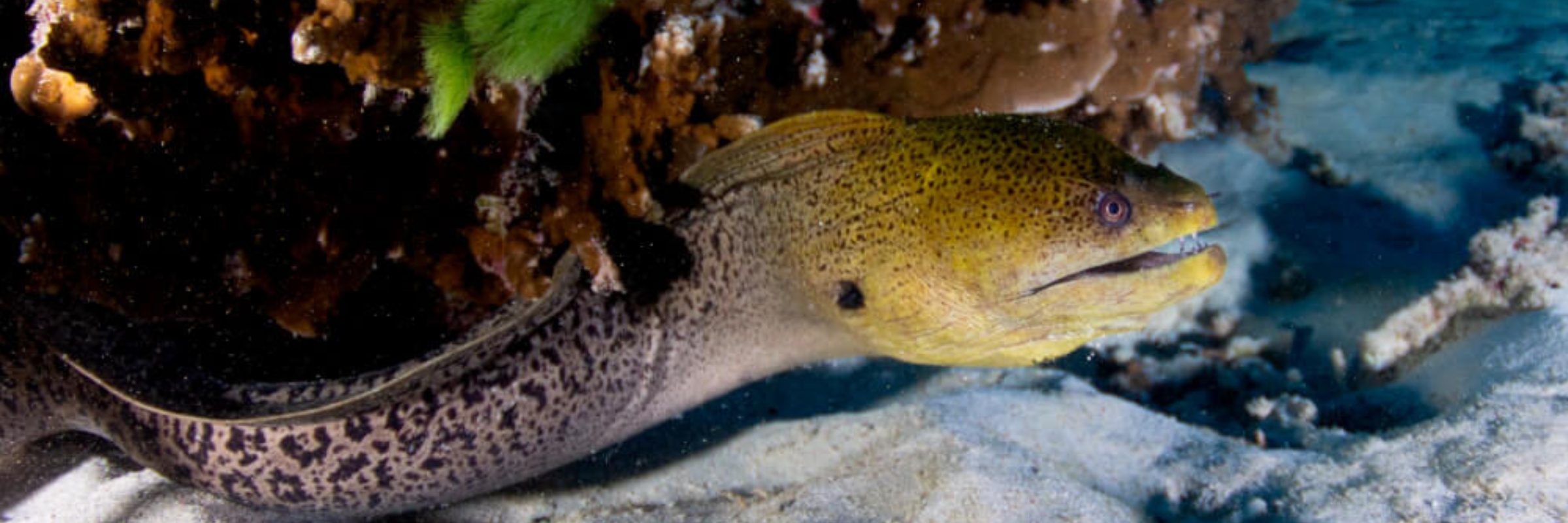
“The moray eel peers from its crevice with those deliberate, unblinking eyes — appearing threatening, but almost always perfectly content to be left alone.”
Moray Eels of the Great Barrier Reef – Mysterious Residents of the Coral
Moray eels are one of the most intriguing and recognisable bony fish found on the Great Barrier Reef. With their long snake-like bodies, wide jaws and watchful eyes peering from coral crevices, these nocturnal predators play an important role in the reef ecosystem.
Despite their somewhat intimidating appearance, they are generally shy and secretive creatures that spend most of their time hiding within coral reefs, rocky holes and underwater caves. Divers and snorkellers exploring the reef often spot them with just their head visible as they breathe by rhythmically opening and closing their mouths.
The Great Barrier Reef is home to many species of moray eel, each adapted to life among coral formations and reef structures.
Moray Eel Taxonomy
Moray eels belong to a specialised group of eel-like fishes.
Scientific classification:
-
- Kingdom: Animalia
- Phylum: Chordata
- Class: Actinopterygii (ray-finned bony fishes)
- Order: Anguilliformes
- Family: Muraenidae
Moray eels are closely related to other eel species but are uniquely adapted for life within coral reefs and rocky habitats.
Appearance
Moray eels have a very distinctive appearance that makes them easy to recognise.
Key features include:
-
- Long snake-like body
- Smooth scaleless skin
- Large mouth with sharp teeth
- Small round eyes
- Continuous dorsal fin running along the body
Unlike many fish, moray eels do not have visible pectoral fins, which contributes to their sleek, serpent-like shape.
They often appear to be opening and closing their mouths, but this behaviour actually helps pump water across their gills for breathing.

Habitat on the Great Barrier Reef
Commonly found throughout the coral reefs and lagoons of the Great Barrier Reef.
They prefer areas where they can easily hide, including:
-
- Coral bommies
- Reef crevices
- Rocky caves
- Coral overhangs
- Reef slopes
During the day they usually remain hidden, emerging at night to hunt.
Diet and Hunting Behaviour
Moray eels are carnivorous predators that hunt mainly at night.
Their diet commonly includes:
-
- Small fish
- Octopus
- Squid
- Crustaceans such as crabs and shrimp
Moray eels have an extraordinary adaptation called pharyngeal jaws, a second set of jaws inside their throat that helps pull prey into the mouth.
This unique hunting mechanism allows them to capture prey in tight reef spaces.

Common Moray Eels on the Great Barrier Reef
Several species can be found across the reef.
Some of the most well-known include:
-
- Giant Moray Eel (Gymnothorax javanicus)
- Honeycomb Moray (Gymnothorax favagineus)
- Yellow-margin Moray (Gymnothorax flavimarginatus)
- Snowflake Moray (Echidna nebulosa)
Each species varies in size, colour pattern and preferred habitat.
Why Moray Eels Are Important to the Reef
Moray eels play a valuable role in maintaining the balance of reef ecosystems.
They help by:
-
- Controlling populations of small reef fish
- Removing weak or injured prey
- Supporting the reef’s natural food chain
Their presence is a sign of a healthy and functioning reef environment.
Interesting Facts
Moray eels have several fascinating traits:
-
- Some species can grow over 3 metres long
- They rely heavily on their sense of smell to locate prey
- They have two sets of jaws for catching food
- They usually hunt at night
- Their skin produces protective mucus instead of scales
- They are generally shy unless threatened
- Divers often see them peeking from coral holes
See them on a reef tour
Moray eels can be seen on outer reef snorkel and dive trips, though sightings are never guaranteed.



Frequently Asked Questions
Are moray eels dangerous to humans?
Why do moray eels open and close their mouths?
How big do moray eels grow?
Where can you see moray eels on the Great Barrier Reef?
What do moray eels eat?
Discover More Great Barrier Reef Fish
Moray eels are just one of the many bony fish species that inhabit the Great Barrier Reef.
Explore more fascinating marine life including:
Each species plays an important role in the complex and vibrant ecosystem of the Great Barrier Reef.
Explore the Great Barrier Reef




A Hot Getaways destination. Where Care is Our Compass.
