

“The seadragon is the reef’s most improbable resident — a fish that looks exactly like drifting seaweed, and moves just as slowly.”
Seadragons – One of Australia’s Most Extraordinary Reef Creatures
This page is part of our Great Barrier Reef Animals Hub, where you can discover the incredible marine life of the reef.
Great Barrier Reef Animals Hub
Seadragons rank among the most beautiful and unusual fish in Australian waters. These delicate marine creatures belong to the Syngnathidae family—alongside seahorses and pipefishes—and stand out for their intricate, leaf-like appendages. These structures provide exceptional camouflage, allowing seadragons to blend seamlessly into seaweed and marine vegetation.
Seadragons are most commonly found in the cooler waters of southern Australia, but they belong to a broader group of fish that also includes reef-dwelling seahorses and pipefishes. Their remarkable camouflage, slow and graceful movements, and distinctive breeding behaviour position them as one of the most fascinating species within Australia’s marine ecosystems, including regions near the southern edges of the Great Barrier Reef.
For divers and ocean enthusiasts, understanding seadragons deepens appreciation for the extraordinary diversity of marine life found across Australian waters.
Extraordinary Camouflaged Relatives of Seahorses
Seadragon Taxonomy
Understanding where seadragons fit in the marine world helps explain their unique features.
Scientific classification:
Kingdom: Animalia
Phylum: Chordata
Class: Actinopterygii (ray-finned fishes)
Order: Syngnathiformes
Family: Syngnathidae
Common relatives: Seahorses and Pipefishes
This family of fish displays several distinctive traits, including elongated bodies, tubular snouts, and the rare phenomenon of male pregnancy.
Types of Seadragons
Only a few species of seadragon exist, and all are native to Australia.
Leafy Seadragon
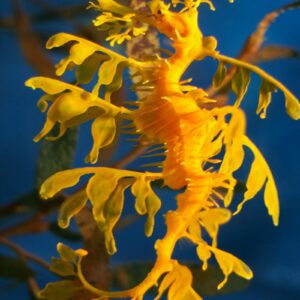
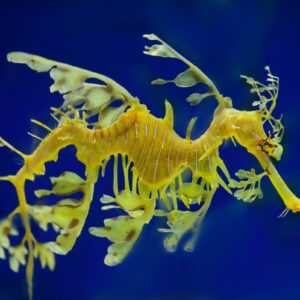
The Leafy Seadragon (Phycodurus eques) stands out for its spectacular leaf-shaped appendages, which closely resemble floating seaweed. These delicate structures provide exceptional camouflage, but the fish does not use them for swimming.
Weedy Seadragon
The Weedy Seadragon (Phyllopteryx taeniolatus) has a more streamlined appearance with fewer appendages but still blends beautifully into kelp forests and seagrass habitats.
Both species are iconic examples of Australia’s unique marine biodiversity.
Appearance and Camouflage
Seadragons are masters of disguise.
Their bodies feature delicate fronds and appendages that mimic seaweed, allowing them to drift invisibly among marine plants. This camouflage helps protect them from predators.
Unlike many fish, seadragons do not rely on speed. Instead they move slowly using small transparent fins that make them appear as if they are simply floating vegetation.
Key features include:
-
- Long tubular snout for sucking up tiny prey
- Leaf-like appendages for camouflag
- Slow, graceful swimming style
- Excellent ability to blend into seaweed and algae
Habitat
Seadragons typically live in coastal marine environments with abundant seaweed and seagrass.
Preferred habitats include:
-
- Kelp forests
- Seagrass meadows
- Rocky reefs with marine vegetation
- Sheltered coastal bays
Although most sightings occur in southern Australia, related species within the Syngnathidae family occur throughout Australian waters, including reef ecosystems connected to the Great Barrier Reef.
Diet
Seadragons are small predators that feed on tiny marine animals.
Using their tube-shaped snout, they suck in prey with surprising speed.
Their diet commonly includes:
-
- Small shrimp
- Mysid crustaceans
- Tiny planktonic animals
- Larval fish
Because they lack teeth, seadragons swallow their prey whole.
Male Pregnancy
One of the most remarkable features of seadragons and their relatives is male pregnancy.
During breeding:
-
- The female produces eggs.
- She transfers them to the male.
- The male carries the eggs until they hatch.
Unlike seahorses, which keep eggs in a pouch, male seadragons carry eggs attached to a special brood patch on the underside of their tail.
After several weeks, tiny baby seadragons emerge and begin life independently.
Why They Are Special
Seadragons are among the most unique fish in the ocean.
Here are a few fascinating facts:
-
- They are found only in Australian waters
- Their leaf-like appendages provide incredible camouflage
- The male carries and protects the eggs
- They swim slowly using small transparent fin
- They are close relatives of seahorses
- Their tubular snout works like a miniature vacuum
- They are protected species in Australia
These extraordinary animals highlight the rich biodiversity of Australia’s marine ecosystems.
Frequently Asked Questions
Are seadragons found on the Great Barrier Reef?
What is the difference between a seahorse and a seadragon?
Why are seadragons called seadragons?
Are seadragons endangered?
Can divers see seadragons?
Discover More Great Barrier Reef Animals
Seadragons are part of a fascinating group of fishes that includes seahorses and pipefishes, all belonging to the Syngnathidae family.
Explore more incredible marine life in our Great Barrier Reef Animals Directory, where you can discover sharks, turtles, reef fish and many other species that make this World Heritage reef one of the most diverse ecosystems on Earth.
Discover Great Barrier Reef Tours


A Hot Getaways destination. Where Care is Our Compass.
