
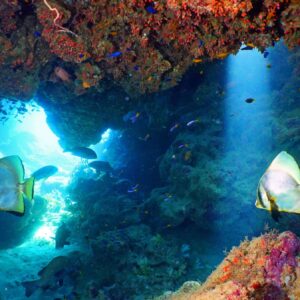
“Batfish appear from nowhere in a calm column of silver and orbit the diver like curious, patient satellites.”
Batfish of the Great Barrier Reef – The Reef’s Most Curious Congregation
Batfish are one of the most endearing fish on the Great Barrier Reef. Tall, flat-bodied, and surprisingly large, they have an almost comical presence — drifting in patient schools around divers and snorkellers with an expression that suggests genuine curiosity. Unlike many reef fish that scatter at the approach of humans, batfish often move closer.


About Batfish
Four species of batfish are recorded on the Great Barrier Reef, including the Round Batfish (Platax orbicularis), also called the Orbicular Batfish, and the Longfin Batfish (Platax pinnatus), also called the Pinnate Batfish. They share the distinctive tall, disc-shaped body profile that makes them so recognisable.
Juvenile Longfin Batfish are one of the most striking fish in the sea — dark brown to black with vivid orange edging on their elongated fins. As they grow, this dramatic juvenile colouration fades and they take on the more muted silver-grey of the adult form.
Adult batfish commonly school in groups of five to thirty fish, hovering in open water near reef structures, wrecks, and buoys. They’re exceptionally approachable, often circling divers and snorkellers without any apparent anxiety.

Quick Facts About Batfish
- Scientific names: Platax species (family Ephippidae). Four are recorded on the Great Barrier Reef: Round Batfish (Platax orbicularis), Longfin Batfish (Platax pinnatus), Roundface Batfish (Platax teira) and Humphead Batfish (Platax batavianus)
- Also known as: spadefish
- Found in: coral reefs, lagoons and sheltered coastal waters; young fish often shelter around mangroves
- Diet: algae, small invertebrates and plankton, including jellyfish and other jelly-like plankton
- Size: up to 45 cm (Longfin Batfish) and 70 cm (Roundface Batfish)
- Lifespan: not well documented in the wild
- Best chance of sighting: adults often hover in mid-water near reef slopes and wrecks, sometimes in schools
Scientific Classification
- Kingdom: Animalia
- Phylum: Chordata
- Class: Actinopterygii (ray-finned fishes)
- Order: Acanthuriformes (formerly Perciformes)
- Family: Ephippidae (batfishes and spadefishes)
- Genus: Platax
- Conservation status: all four reef species are listed as Least Concern (IUCN)
Common Names
- Primary common name: Batfish
- Other names: spadefish; the Round Batfish is also called the Orbicular Batfish, and the Longfin Batfish is also called the Pinnate Batfish
Related Species
- Round Batfish (Platax orbicularis)
- Longfin Batfish (Platax pinnatus)
- Roundface Batfish (Platax teira)
- Humphead Batfish (Platax batavianus)
Identification Notes
Adult batfish are silvery and disc-shaped, with a dark bar running through the eye. The Roundface Batfish has a dark blotch below the pectoral fin, and the Round Batfish has black edges on its back and belly fins. Young fish look completely different: juvenile Longfin Batfish are black with a bright orange edge, while juvenile Round Batfish drift like dead leaves.
Role on the Reef
Batfish graze algae and eat small invertebrates and jelly-like plankton. In a Great Barrier Reef experiment, researchers found the Longfin Batfish was the main fish that cleared seaweed from overgrown reef plots, helping the coral recover (Bellwood, Hughes and Hoey, 2006).
Learning about reef fish in class? We help schools, universities and study groups plan educational trips to the Great Barrier Reef. Depending on the program, groups can enjoy guided snorkelling and marine biology presentations.
Great Barrier Reef Educational Groups →
Behaviour and Diet
Batfish feed on algae, invertebrates, and small jellyfish, and are found at depths ranging from very shallow reef areas down to 30 metres or more. They’re often seen at cleaning stations — hovering with their fins spread while small cleaner wrasse remove parasites from their bodies.
Where to See Batfish
Batfish are a highlight of many dive and snorkel sites across the Great Barrier Reef. They’re commonly encountered near coral heads, around wrecks, and at outer reef wall sites throughout the Cairns, Port Douglas, and Whitsunday reef regions.
A Hot Getaways destination. Where Care is Our Compass.
FAQs
What do batfish look like?
Why do batfish swim towards divers?
Where can I see batfish on the Great Barrier Reef?
Are batfish dangerous?
How should I behave around batfish?