

“The box jellyfish is real, it is seasonal, and knowing the facts keeps you safe. Honest information is part of every good reef experience.”
Box Jellyfish and Irukandji – What Every Reef Visitor Should Know
In short: Box jellyfish and Irukandji are real risks in tropical Queensland, but they are overwhelmingly a coastal and inshore problem rather than an outer-reef one. The higher-risk marine stinger season runs from about November to May, stinger suits are the single most effective precaution, and vinegar plus an immediate call to 000 is the first response to any tropical jellyfish sting.
This page answers: What box jellyfish and Irukandji actually are, when and where the risk is highest, how likely you are to encounter them on a reef trip, what protection works, and exactly what to do if someone is stung.
Every first-aid statement on this page is a short summary of guidance published by Surf Life Saving Queensland and Queensland Health, and is linked to the original. Verified 1 August 2026.
In an emergency, act first. If someone is stung by a box jellyfish or you suspect Irukandji syndrome: get them out of the water if it is safe to do so, call 000, start CPR if they are unresponsive and not breathing normally, and pour vinegar over the sting for at least 30 seconds before removing any tentacles. Keep them out of the water and watch them closely. On a reef tour, tell the crew immediately.
Follow the instructions of emergency services and the recognised authorities — Surf Life Saving Queensland and Queensland Health. Their guidance takes precedence over this page and it does change. What follows is a plain-English summary written so you are not trying to read a travel website during an emergency.
Box jellyfish and Irukandji are among the most important safety considerations for swimmers and snorkellers in tropical Queensland. Understanding the facts — including when they appear, where they’re typically found, and how to minimise risk — allows visitors to make informed decisions and enjoy the reef safely.


Box Jellyfish (Chironex fleckeri)
The Box Jellyfish (Chironex fleckeri) is one of the most venomous marine creatures in the world. Encounters can be life-threatening, and stings to large areas of skin require immediate emergency treatment.
Box jellyfish live in shallow tropical Australian waters north of Agnes Water in Queensland, and Surf Life Saving Queensland records stings predominantly in coastal areas rather than offshore. They are not typically encountered on outer reef tours in open ocean conditions. Marine stingers can be present in tropical Queensland waters at any time of year, but the risk is higher during the marine stinger season, which Surf Life Saving Queensland describes as typically running from November through to May.
Prevention: Stinger suits are the most effective protection. Most reputable offshore reef tour operators provide stinger suits for snorkellers during stinger season. Swim at patrolled beaches within stinger enclosures during peak season.
First aid — the immediate action. Following Surf Life Saving Queensland: remove the casualty from the water if it is safe to do so, call 000 for an ambulance and ask a lifeguard for help if one is available, assess the casualty and start CPR immediately if it is needed, then pour vinegar over the sting for at least 30 seconds before picking off any tentacles. If there is no vinegar, pick the tentacles off (this will not harm the rescuer) and rinse well with sea water. Do not use fresh water and do not rub the area. Apply a cold pack or ice in a dry plastic bag for pain. Antivenom for Chironex fleckeri is held at hospitals and ambulance stations in tropical coastal areas. This is a summary only — follow the instructions of emergency services and the current guidance published by Surf Life Saving Queensland and Queensland Health.
A bluebottle sting is different: do not use vinegar. Rinse with sea water, then place the area in hot water (as hot as is comfortable) for 20 minutes, or use a cold pack if hot water is not available.
Irukandji Jellyfish
Irukandji are tiny, nearly invisible jellyfish (typically 1–2cm across the bell) whose sting causes Irukandji Syndrome — a serious, delayed reaction that includes intense muscle cramping, severe back pain, nausea, and in rare cases, hypertension and pulmonary oedema.
Unlike Box Jellyfish, Irukandji can be found in deeper water including offshore reef environments, and have been encountered on reef tours during stinger season. Their small size makes them impossible to see in the water.
Prevention: Stinger suits provide reasonable protection. As with box jellyfish, the higher-risk period is the marine stinger season from roughly November to May, although Surf Life Saving Queensland notes that marine stingers may be present in tropical Queensland waters throughout the year.
First aid — the immediate action. Following Surf Life Saving Queensland: remove the casualty from the water if it is safe to do so, follow DRSABCD, call 000 for an ambulance, douse the sting liberally with vinegar for at least 30 seconds, then keep the person out of the water in a safe place and monitor them for 45 minutes. The initial sting is often minor; the serious symptoms typically follow 5 to 40 minutes later, which is why anyone stung must be watched rather than sent back into the water. Because the delay makes Irukandji hard to identify at the time, Surf Life Saving Queensland advises that all tropical jellyfish stings be doused with vinegar. Again, this is a summary — follow emergency services and the authorities linked below.

Stinger Season and Reef Tours
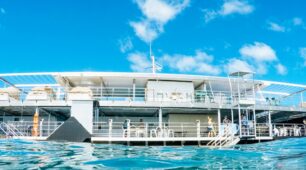
Most reputable Great Barrier Reef tour operators take stinger safety seriously. During stinger season (October–May), stinger suits are provided or strongly recommended. Offshore reef tours in open-ocean conditions carry a lower risk than beach swimming during this period.
Visitors should always follow operator safety briefings and wear provided stinger protection.
How the Risk Differs Between the Beach and the Outer Reef
This is the distinction that matters most to a visitor, and it is the one most often blurred. Box jellyfish are a shallow, sheltered, inshore animal: Surf Life Saving Queensland records their stings predominantly in coastal areas, and their range in Queensland begins north of Agnes Water. The mainland beaches around Cairns, Port Douglas and Palm Cove sit squarely inside that range, which is why those beaches have stinger enclosures and why the netted area matters during the season.
Outer reef sites are a different environment — deep, open ocean, many kilometres from the coast — and box jellyfish are not typically found there. Irukandji are the genuine exception. They are small, effectively invisible in the water, and they have been recorded in deeper water including offshore. That is the honest position: an outer reef trip substantially reduces box jellyfish risk, and reduces but does not eliminate Irukandji risk.
The practical conclusion is not to avoid the water. It is to wear the stinger suit that your operator provides, and to treat the suit as normal equipment during the season rather than an optional extra for the nervous.
What a Stinger Suit Does, and What It Does Not Do
A stinger suit is a thin full-length lycra suit, usually with a hood and thumb loops. It works by physically preventing tentacle contact with skin, which is the only way a sting can occur. It is not a wetsuit and provides very little warmth, which is rarely a problem in tropical water.
What it does not do is cover every square centimetre of you. The face is the usual gap. A suit dramatically reduces exposed skin, and that is the whole mechanism, but it is a reduction in risk rather than an elimination of it. Anyone who tells you a lycra suit makes stings impossible is overstating the case.
Most operators running trips during the season provide suits, and many include them at no extra charge. If you are booking between November and May it is worth confirming this at the time of booking rather than discovering it on the boat. Some visitors prefer to bring their own, which is perfectly reasonable and means a guaranteed fit.
Why Vinegar, and Why the Order Matters
Vinegar does not relieve pain and it does not treat venom that has already entered the body. What it does is deactivate the stinging cells — the nematocysts — that are still sitting on the skin and have not yet fired. That is why Surf Life Saving Queensland puts vinegar before tentacle removal for box jellyfish stings: pulling at tentacles that are still live can trigger further discharge.
Queensland Health makes the same point from the other direction, noting that vinegar inactivates the nematocyst but does not relieve pain from venom already delivered. Both statements are consistent, and both are worth understanding, because a visitor who expects vinegar to make the pain stop may conclude it has not worked and stop using it.
Fresh water has the opposite effect to the one people expect and should not be used. Nor should alcohol, urine, or rubbing the area. Reef vessels operating in stinger season carry vinegar; at patrolled beaches it is kept with the lifeguards and at the stinger enclosures.
More Questions About Box Jellyfish and Irukandji
Do I need a stinger suit on an outer reef trip?
During the marine stinger season, which Surf Life Saving Queensland describes as typically November to May, yes — wear one. Box jellyfish are unlikely that far offshore, but Irukandji have been recorded in deeper water and are impossible to see. Outside the season most operators still make suits available and many snorkellers wear them anyway for sun protection.
Can you see a box jellyfish or an Irukandji in the water?
Realistically, no. Box jellyfish are large but almost transparent, and Irukandji are only one to two centimetres across the bell. Visual spotting is not a safety strategy for either animal, which is why the advice is built around suits, enclosures and patrolled beaches rather than looking out for them.
How soon do Irukandji symptoms appear?
The initial sting is often mild. Surf Life Saving Queensland states that the severe symptoms typically follow five to forty minutes later, which is why anyone stung by any tropical jellyfish should be kept out of the water and monitored for forty-five minutes rather than assumed to be fine.
Is vinegar carried on reef boats?
Vessels operating in tropical Queensland during the stinger season carry vinegar as standard first-aid equipment, and crews are trained in its use. If you are stung, tell the crew rather than treating it yourself — they will have the vinegar, the oxygen and the radio.
Are stinger enclosures completely safe?
Stinger enclosures at patrolled beaches are designed to exclude box jellyfish and greatly reduce risk, and they are the right place to swim during the season. They are not a guarantee against the much smaller Irukandji. Swim between the flags, inside the enclosure, and wear a suit — the three together are what the lifesavers recommend.
What should I do if I am stung and no one else is around?
Get out of the water, call 000, and douse the area with vinegar if you have any. Do not drive yourself anywhere and do not go back in the water. Because Irukandji symptoms are delayed, a sting that seems minor still needs someone to know about it and to check on you.
Sources and Further Reading
Every figure on this page comes from one of the sources below. We link to the source rather than paraphrase it so that you can check our work.
- Surf Life Saving Queensland — Marine Stingers — Species descriptions, distribution and the official first aid sequence for box jellyfish, Irukandji and bluebottle stings. This is the source for the first aid summarised on this page.
- Surf Life Saving Queensland — North Queensland Beach Safety — Beach safety advice written specifically for tropical North Queensland, including stinger season dates, stinger suits and swimming in netted enclosures.
- Queensland Health (Queensland Government) — Bites and Stings — The state health authority on first aid for bites and stings, including the use of vinegar for suspected Irukandji, jimble, sea anemone and box jellyfish stings.
Every source above was opened and confirmed live on 1 August 2026. First aid guidance is reviewed periodically by the organisations that publish it. Where this page and an authority disagree, the authority is right and we are out of date — please tell us so we can correct it.
A Hot Getaways destination. Where Care is Our Compass.
FAQs
When is box jellyfish and Irukandji season in Queensland?
Are box jellyfish found on the outer Great Barrier Reef?
How can I protect myself from jellyfish stings?
What is the first aid for a box jellyfish sting?
What is Irukandji syndrome?
