
“Reef-safe sunscreen is not just about your skin — it’s about the coral you’re swimming over. The difference matters.”
Reef Safe Sunscreen – Why It Matters and What to Use
In short: Wear a rash shirt. It is the single most effective thing you can do for both your skin and the reef, because it protects the areas that need the most sunscreen and removes the need to apply any there at all. For the skin still exposed, use a broad-spectrum, water-resistant SPF 50 or 50+ sunscreen, and choose a mineral one based on zinc oxide or titanium dioxide if you want to reduce what washes off into the water.
This page answers: What “reef safe” actually means and does not mean, which ingredients are debated and how strong the evidence really is, what to look for in a sunscreen you buy in Australia, and how to protect yourself properly on a reef trip.
Sun protection guidance on this page follows the Queensland Government. The sunscreen-and-coral question is treated as unsettled, because it is. Sources verified 1 August 2026.
Reef Safe Sunscreen Protect Your Skin and the Great Barrier Reef
Reef Safe Sunscreen – What You Need to Know
- Reef safe sunscreen helps protect coral ecosystems by avoiding ingredients commonly linked to coral stress, while still providing essential sun protection for visitors to the Great Barrier Reef.
- Always check the active ingredients, as “reef safe” is a marketing term many reef-conscious travellers choose sunscreens without oxybenzone or octinoxate.
- Mineral sunscreens using zinc oxide or titanium dioxide are often preferred for reef activities, as they sit on the skin and reflect UV rays rather than absorbing them.
- SPF 50 or 50+ broad-spectrum protection is essential in tropical North Queensland, where UV levels are high year-round, especially on the water.
- Water-resistant sunscreen is important for snorkelling and swimming, helping maintain protection while reducing how often sunscreen needs to be reapplied.
- Applying sunscreen before entering the water helps minimise product wash-off into the ocean and ensures better sun protection from the start.
- Combining sunscreen with rash vests, hats and shade reduces overall sunscreen use and is one of the most reef-friendly ways to stay sun safe.
- Spending time on the Great Barrier Reef is one of the highlights of any Australian holiday crystal-clear water, colourful coral, and incredible marine life. With Queensland’s strong tropical sun, sunscreen is essential, but choosing the right sunscreen also helps protect this fragile reef ecosystem.
- This guide explains what reef safe sunscreen really means, which ingredients to look for (and avoid), and how to stay sun-safe while minimising your impact on the reef.
What Is Reef Safe Sunscreen?
Reef safe sunscreen refers to sun protection products designed to be less harmful to coral reefs and marine life. While the term “reef safe” is commonly used, it isn’t officially regulated, so the most important step is checking the active ingredients on the label.
Many visitors to the Great Barrier Reef choose reef-conscious sunscreens as part of responsible reef tourism alongside wearing rash vests, hats, and following reef safety guidelines.
Why Reef Safe Sunscreen Matters on the Great Barrier Reef
The Great Barrier Reef is a living ecosystem facing many challenges, including warming oceans, storms, and water quality. Research into sunscreen ingredients and coral health is ongoing and the science is still developing. Laboratory studies have raised concerns about certain ultraviolet filters, and several jurisdictions overseas have restricted them, but how much difference this makes in open reef conditions is not settled, and we are not going to pretend otherwise.
What we can say without overstating anything is this: choosing a mineral-based product and covering up both reduce the amount of sunscreen entering the water, neither costs you any sun protection, and both are easy to do. That is reason enough to do them, and it does not require the science to be settled first.
The Two Ingredients Most Often Named
Two ingredients come up repeatedly in this discussion. They are the ones restricted in some overseas marine destinations and the ones most often named on “reef safe” packaging:
-
- Oxybenzone (also called benzophenone-3)
- Octinoxate (also called ethylhexyl methoxycinnamate)
It is worth being precise about what that means. These ingredients are commonly flagged in reef protection discussions, and restrictions exist in some marine environments overseas. There is no Australian ban, and the Reef Authority’s published Responsible Reef Practices guidance does not currently single out sunscreen among the pressures it asks visitors to manage. That absence is itself informative: on the Great Barrier Reef, the pressures the science and the managing authority concentrate on are ocean warming, water quality and physical damage. Sunscreen is a reasonable thing to be thoughtful about; it is not the main thing.
What to Look for in a Reef Safe Sunscreen (Australia-Friendly)
For Great Barrier Reef tours, your sunscreen should protect you first — while being as reef-conscious as possible.
Look for sunscreen that is:
-
- SPF 50 or 50+
- Broad-spectrum (protects against UVA and UVB rays)
- Water-resistant
- TGA-compliant (approved for use in Australia)
- Uses mineral (physical) filters such as zinc oxide and/or titanium dioxide, if you’re aiming for a reef friendlier option
Mineral sunscreens sit on the skin and reflect UV rays, rather than absorbing them, and are often preferred by reef-conscious travellers.
How to Use Sunscreen Responsibly on the Reef
Using sunscreen properly helps protect both your skin and the reef:
-
- Apply sunscreen 20 minutes before swimming or snorkelling
- Use a generous amount — most people don’t apply enough
- Reapply every two hours, or after swimming or towel drying
- Apply before boarding your boat where possible, not in the water
- Combine sunscreen with rash vests, hats, and shade to reduce how much sunscreen you need overall
Reef Smart Sun Protection Tips
-
- Choose reef safe sunscreen with SPF 50 or 50+
- Avoid sunscreens with oxybenzone and octinoxate
- Don’t rely on marketing claims check the ingredients
- Wear a long-sleeve rash vest when snorkelling
- Reapply sunscreen properly to maintain protection
- Use shade and smart timing during peak UV hours
- Follow reef safety advice from your tour crew
Frequently Asked Questions
Is reef safe sunscreen mandatory on the Great Barrier Reef?
Is mineral sunscreen better for the reef?
What SPF should I use on a reef tour?
Can I rely on sunscreen alone for sun protection?
Can I buy reef safe sunscreen in Cairns or Port Douglas? Yes. Reef-conscious sunscreens are widely available in local pharmaci
A Simple Way to Care for the Reef
A Simple Way to Care for the Reef
Choosing reef safe sunscreen is a small but meaningful step you can take to help protect one of the world’s greatest natural wonders. Combined with smart sun protection habits and respectful reef behaviour, it helps ensure the Great Barrier Reef can be enjoyed for generations to come.
Things to Do on the Great Barrier Reef


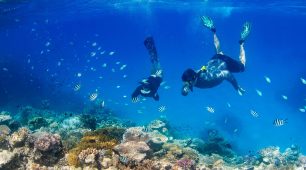
Cover Up First. It Works Better Than Anything Else.
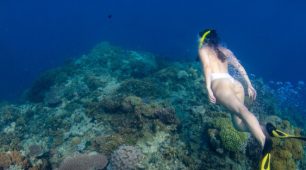
If you take one thing from this page, take this. The most effective way to reduce sunscreen entering the water is to need less of it, and the way to need less of it is to wear a shirt. A rash shirt or a lycra stinger suit covers your back, shoulders and upper arms — precisely the surfaces that face straight up at the sun while you are floating face-down over coral, and precisely the surfaces where sunscreen is hardest to apply properly and quickest to wash off.
This is not an environmental compromise dressed up as advice. Queensland has the highest rate of skin cancer in Australia, and the Queensland Government’s first sun-protective behaviour is to slip on a shirt — one with good coverage including a collar and long sleeves, in a closely woven fabric, with an ultraviolet protection factor. A shirt does not wear off after two hours, cannot be applied too thinly, and does not need reapplying after a swim. Sunscreen is the fallback for the skin a shirt cannot cover, not the primary defence.
Most reef operators provide lycra suits during stinger season and many have them available year-round. Wearing one outside the season for sun protection alone is completely normal and nobody will think it odd.
What the Evidence Actually Supports
We think it is worth separating what is well established from what is still being worked out, because “reef safe” marketing tends to blur the two.
| Statement | How well supported |
|---|---|
| Queensland has extreme UV levels and sun protection is essential | Well established. Queensland Government public health guidance, and the Bureau of Meteorology publishes a daily UV index forecast you can check before you travel. |
| Broad-spectrum, water-resistant SPF 50 or 50+ is the right choice for a reef day | Well established. This is the Queensland Government recommendation. |
| Clothing is a more reliable barrier than sunscreen | Well established and is why “slip on a shirt” comes first in the official advice. |
| Mineral filters reduce the chemical load entering the water | Reasonable and low risk. Zinc oxide and titanium dioxide work by sitting on the skin rather than being absorbed. Choosing them costs you nothing. |
| Oxybenzone and octinoxate harm coral on the Great Barrier Reef | Not settled. Concerns come largely from laboratory work, some overseas jurisdictions have restricted these ingredients, and research continues. We have not found an Australian government or research-organisation source that states this as established fact for the Great Barrier Reef, and until we do we will not write it as one. |
| “Reef safe” on a label means something specific | No. It is a marketing term with no regulated definition in Australia. Read the active ingredients rather than the front of the bottle. |
If an authoritative Australian source publishes a clear position on sunscreen ingredients and coral, we will update this page and say so. Until then, the honest answer is that the precaution is cheap and sensible, and the certainty is not there.
More Questions About Sunscreen and the Reef
Is reef safe sunscreen a regulated term in Australia?
No. There is no legal definition and no certification behind it, so a bottle labelled reef safe is making a marketing claim rather than meeting a standard. What is regulated is the sunscreen itself: therapeutic sunscreens sold in Australia are regulated by the Therapeutic Goods Administration. Judge a product on its active ingredients and its SPF rating, not on the wording across the front.
Do I still need sunscreen if I wear a rash shirt?
Yes, for everything the shirt does not cover — face, ears, neck, hands, feet and the backs of the legs. The point of the shirt is not to replace sunscreen entirely but to remove the largest and most awkward area from the equation. It also means the sunscreen you do apply gets applied properly, because you are covering a small area rather than rushing over your whole back on a moving boat.
Will a mineral sunscreen protect me as well as a chemical one?
A mineral sunscreen rated broad-spectrum SPF 50 or 50+ and water-resistant meets the same standard as any other product with that rating. Mineral formulations can feel thicker and may leave a white cast, which is a cosmetic difference rather than a protective one. Protection comes from the rating and from applying enough of it, not from the type of filter.
When should I put sunscreen on for a reef trip?
Apply it twenty minutes before you go in, and where possible before you board rather than on deck or in the water. Applying before boarding gives it time to bind to your skin, means less of it rinses straight off, and spares you trying to reach your own shoulders on a moving vessel. Reapply every two hours and after every swim or towel dry.
How strong is the UV really?
Strong enough that the usual instincts do not apply. Tropical North Queensland has high UV year-round, not only in summer, and reflection off water increases exposure while wind and cool water hide the sensation of burning. The Bureau of Meteorology publishes a daily UV index forecast, and it is worth a look the night before a reef day.
Sources and Further Reading
Every figure on this page comes from one of the sources below. We link to the source rather than paraphrase it so that you can check our work.
- Queensland Government — Reduce the risk of skin cancer — The five sun-protective behaviours, including the recommendation to slip on a shirt with good coverage and an ultraviolet protection factor, and to use broad-spectrum water-resistant SPF 50 or higher. This is the source for the sun protection advice on this page.
- Bureau of Meteorology — Ultraviolet (UV) Index Forecast — The official daily UV index forecast for Australian locations. Worth checking before a reef day.
- Reef Authority — Responsible Reef Practices — The managing authority’s guidance on how to behave in the Marine Park. Noted here for transparency: it does not currently single out sunscreen, which is part of why we treat the sunscreen question as a sensible precaution rather than a major pressure.
Every source above was opened and confirmed live on 1 August 2026. The sunscreen and coral question is treated on this page as unsettled because we could not find an Australian government or research-organisation source stating a clear position. If that changes we will update this page and say what changed.
A Hot Getaways destination. Where Care is Our Compass.