

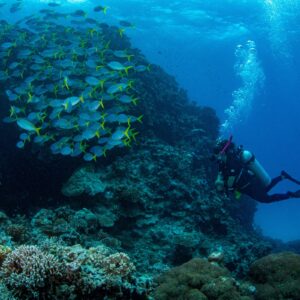
“Fusiliers stream through open water in glittering schools, silver-and-yellow flashes that fill the blue with movement and colour.”
Fusiliers of the Great Barrier Reef – Schooling Fish of the Open Water
Quick Facts About the Fusiliers Great Barrier Reef
• Scientific name: Caesio species (family Caesionidae)
• Also known as: Fusilier fish, reef schooling fish
• Found in: Coral reefs, outer reef slopes and drop-offs
• Diet: Plankton and small marine organisms
• Average length: 20–40 cm
• Conservation status: Least Concern
• Best chance of sighting: Outer reef snorkelling and dive sites
What Are Fusiliers?
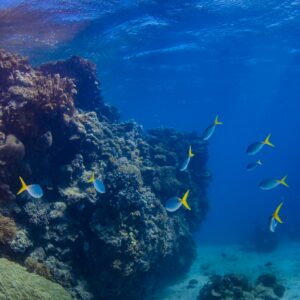
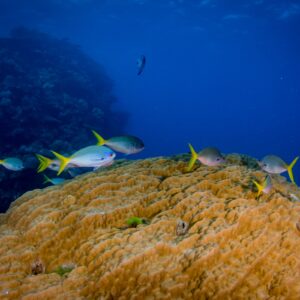
The Fusiliers Great Barrier Reef are fast-swimming, colourful schooling fish commonly seen darting across reef slopes in large groups. Known for their streamlined bodies and shimmering blue, yellow and silver colours, fusiliers bring movement and energy to the reef environment.
These fish are typically found in large schools, often swimming together in synchronised patterns above coral formations. Their behaviour not only creates a spectacular visual display for snorkellers and divers but also plays an important role in the reef’s food chain.
Fusiliers feed on plankton in the water column, linking the open ocean with reef ecosystems. Their constant movement helps transfer nutrients across the reef, supporting the broader marine environment.
Related reef life to explore:
→ Clownfish
→ Reef Fish Hub
→ Reef Tours from Cairns
Scientific Classification
• Kingdom: Animalia
• Phylum: Chordata
• Class: Actinopterygii
• Order: Perciformes
• Family: Caesionidae
• Genus: Caesio (and related genera)
• Species: Multiple species across the reef
Conservation Status (IUCN):
Least Concern
Protection under Australian law:
Managed within the Great Barrier Reef Marine Park
Where Do Fusiliers Live on the Great Barrier Reef?
Fusiliers are most commonly found in outer reef environments, especially:
• Coral reef slopes
• Drop-offs and reef edges
• Open water above coral formations
• Areas with strong water movement
They prefer locations where ocean currents bring a steady supply of plankton. This is why they are often seen in large numbers on outer reef dive sites.
Visitors joining Cairns Reef Tours or Port Douglas Reef Tours frequently encounter schools of fusiliers swimming in mid-water above the reef.
Many popular locations in the Dive Site Directory, including Flynn Reef and Norman Reef, are excellent places to observe these vibrant schooling fish.
What Do Fusiliers Eat?
Fusiliers primarily feed on plankton drifting in the water column.
Their feeding behaviour includes:
• Constant swimming to capture plankton
• Feeding in mid-water above the reef
• Moving with currents to find food-rich areas
By feeding on plankton, fusiliers play an important ecological role by transferring nutrients from open water into reef ecosystems, supporting other marine life.
Can You See Fusiliers on a Reef Tour?
Yes , fusiliers are commonly seen on reef tours and are one of the most visually striking fish on the Great Barrier Reef.
You are most likely to see them:
• On outer reef snorkelling sites
• While scuba diving along reef drop-offs
• In clear water with good visibility
• In areas with moderate current
Their schooling behaviour creates beautiful underwater scenes, often surrounding divers in shimmering clouds of colour.
Planning a reef trip?
Explore Great Barrier Reef Tours from Cairns
7 Interesting Facts About the Fusiliers Great Barrier Reef
- Fusiliers are known for forming large, fast-moving schools.
- Their streamlined bodies allow them to swim quickly in open water.
- They often change colour slightly depending on light and depth.
- Fusiliers feed continuously throughout the day on plankton.
- Their schooling behaviour helps protect them from predators.
- They are an important food source for larger reef fish like trevally and reef sharks.
- Schools of fusiliers create some of the most memorable snorkelling and diving experiences on the reef.
Fusiliers Conservation on the Great Barrier Reef
Fusiliers are currently considered stable, but like all reef species, they rely on a healthy coral reef ecosystem.
Potential threats include:
• Coral reef degradation
• Climate change and ocean warming
• Changes in plankton availability
• Overfishing in some regions globally
The protection of the Great Barrier Reef Marine Park helps ensure fusiliers continue to thrive in Australian waters.
Learn more:
→ Reef Conservation
→ Reef Safety
→ Coral Bleaching
Frequently Asked Questions – Fusiliers Great Barrier Reef
Are fusiliers common on the Great Barrier Reef?
Are fusiliers dangerous?
Why do fusiliers swim in schools?
What do fusiliers eat on the Great Barrier Reef?
Can I see fusiliers while snorkelling?
Discover the Fusiliers Great Barrier Reef Experience
The Fusiliers Great Barrier Reef are one of the most dynamic and visually stunning fish species you will encounter while exploring the reef. Their fast-moving schools bring energy, colour and life to the underwater world.
Whether you are snorkelling or diving, watching a school of fusiliers glide effortlessly through the water is an unforgettable experience that highlights the beauty and diversity of the Great Barrier Reef.
Continue your reef journey:
→ Compare Reef Tours
→ Reef Animals Hub
Animals Commonly Seen With Fusiliers
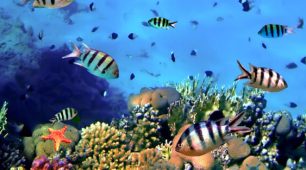
Fusiliers are often seen swimming alongside other reef species, including:
→ Trevally
→ Reef Sharks
→ Barracuda
→ Coral Trout
These interactions create exciting underwater scenes and demonstrate the interconnected nature of reef ecosystems.
Discover Great Barrier Reef Tours



A Hot Getaways destination. Where Care is Our Compass.