
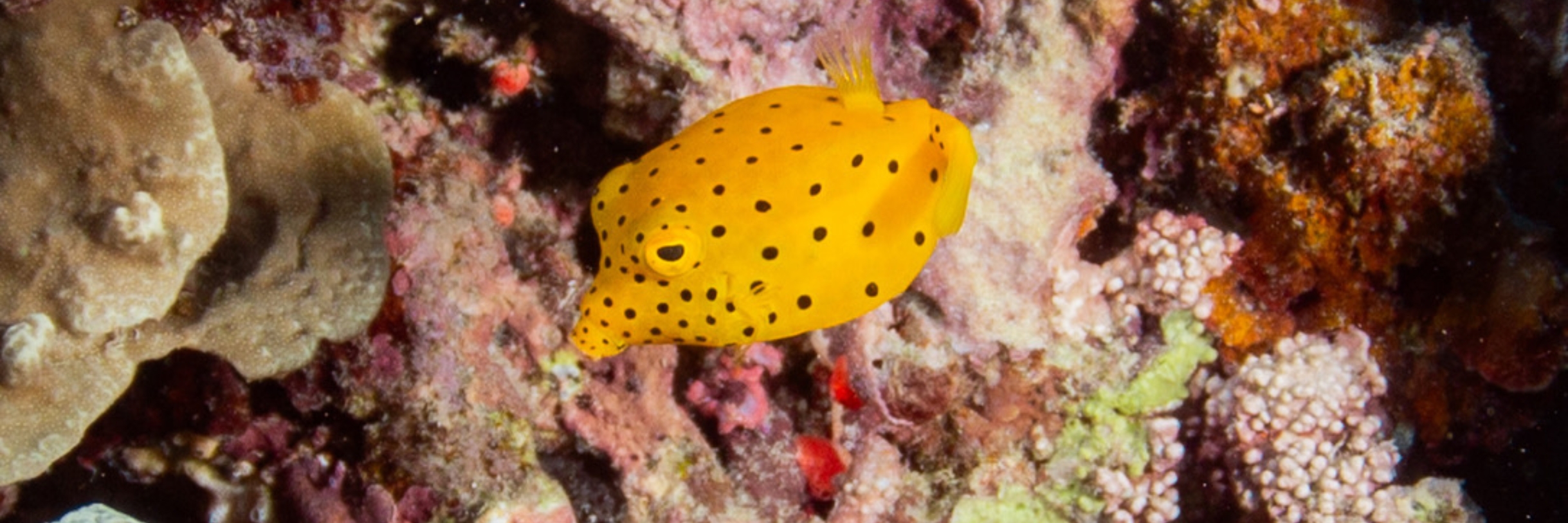
“The yellow boxfish looks like it was designed by someone who had never seen a fish before, and somehow got everything exactly right.”
The Reef’s Little Yellow Cube: Understanding the Yellow Boxfish
The yellow boxfish (Ostracion cubicus) is one of the most charming and distinctive fish on the Great Barrier Reef, a small, almost perfectly box-shaped creature that moves through the water with a peculiar, hovering grace, rotating its fins like tiny propellers to navigate around coral formations. Juveniles are a vivid, clear yellow covered in black spots. Adults fade to yellowish-brown or bluish tones with a honeycomb pattern. All of them inspire immediate delight in anyone who encounters them.
Watch this marine life in action on the GreatBarrierReefTours.com YouTube Channel and subscribe for more incredible Great Barrier Reef wildlife videos.
Identification
Juvenile yellow boxfish are unmistakable — bright chrome yellow, roughly cubic in shape, with black spots distributed evenly across the body. They look almost artificial, like something a child designed. As boxfish mature, the colouration shifts: males typically develop blue-grey flanks and orange-yellow patches, while females retain yellowish tones with darker spotting. The boxy shape persists throughout life — the fish is enclosed within a rigid carapace of fused bony plates that covers almost the entire body, leaving only the fins, eyes, mouth, and tail free to move.
The Boxy Body Plan
The rigid carapace of the boxfish serves as armour against predators but creates a significant hydrodynamic challenge. Rather than using body flexion for swimming — as most fish do — the boxfish sculls through the water using its pectoral, dorsal, anal, and caudal fins in a coordinated, hovering motion. It is a remarkably agile mover for a fish with so little flexibility, capable of precise manoeuvreing around reef structures and into reef crevices. At higher speeds, the carapace shape generates hydrodynamic lift that actually stabilises the fish — a design so efficient it has been studied by automotive engineers.
Diet and Behaviour
Yellow boxfish feed on sponges, algae, worms, molluscs, and small crustaceans, which they locate and extract from reef surfaces and substrate using a small, protruding mouth. They are generally solitary and slow-moving, navigating their reef territories in a leisurely fashion that makes them easy to observe and photograph. Males maintain territories and will display to rival males, but interactions are rarely dramatic.
A Chemical Surprise
One of the yellow boxfish’s most remarkable defences is chemical rather than physical. When stressed or threatened, the fish can release a toxic skin secretion called pahutoxin — a defence mechanism that can be lethal to other fish in confined conditions. This toxin is of significant scientific interest and has implications for understanding chemical defences in reef ecosystems. Snorkellers and divers need not be concerned — this toxin is only dangerous in very confined conditions and is not activated by normal, respectful observation.
A Hot Getaways destination. Where Care is Our Compass.
Quick Facts About the Yellow Boxfish
- Scientific name: Ostracion cubicus (also spelt Ostracion cubicum)
- Also known as: Cubed Boxfish, Blue-spotted Boxfish, Polka Dot Boxfish, Yellow Trunkfish
- Found in: coral and rocky reefs, from about 1 m to 50 m deep; young fish often shelter among branching coral
- Diet: algae and small sea-floor animals, including sponges, worms, molluscs and crustaceans
- Size: up to 45 cm
- Lifespan: not well documented
- Best chance of sighting: adults alone near ledges and crevices; juveniles among branching coral
Scientific Classification
- Kingdom: Animalia
- Phylum: Chordata
- Class: Actinopterygii (ray-finned fishes)
- Order: Tetraodontiformes (pufferfishes and their relatives)
- Family: Ostraciidae (boxfishes and cowfishes)
- Genus: Ostracion
- Species: Ostracion cubicus
- Conservation status: Least Concern (IUCN)
Common Names
- Primary common name: Yellow Boxfish
- Secondary common name: Cubed Boxfish
- Other names: Blue-spotted Boxfish, Polka Dot Boxfish, Yellow Trunkfish
Related Species
- Black Boxfish (Ostracion meleagris), far northern Great Barrier Reef
- Reticulate Boxfish (Ostracion solorense), northern Great Barrier Reef
- Thornback Cowfish (Lactoria fornasini), far northern Queensland
Identification Notes
Young fish are bright yellow with black spots and a rounded body. As they grow they turn yellowish-brown to bluish, with blue-ringed dark spots, and adults have a squarer box shape, a honeycomb pattern and a small bump above the mouth.
Role on the Reef
Boxfish feed on algae and small animals picked from the reef surface. Their skin can release a toxic secretion (pahutoxin) that protects them from predators.
Learning about reef fish in class? We help schools, universities and study groups plan educational trips to the Great Barrier Reef. Depending on the program, groups can enjoy guided snorkelling and marine biology presentations.
Great Barrier Reef Educational Groups →
Find Your Great Barrier Reef Tour

FAQs
What does a yellow boxfish look like?
Why is the yellow boxfish shaped like a box?
How does the yellow boxfish swim?
Is the yellow boxfish dangerous?
Where can I see yellow boxfish on the Great Barrier Reef?