

“The angelfish doesn’t announce itself. It simply materialises from the coral, regal and unhurried, as if it owns the whole reef.”
Angelfish of the Great Barrier Reef – Colour, Grace and Coral Architecture
Angelfish are among the most visually striking fish on the Great Barrier Reef. Their flat, disc-shaped bodies, vivid colour patterns, and elegant, slow-moving style make them immediately recognisable — and one of the most photographed fish on any reef snorkel or dive.


Angelfish Species on the Great Barrier Reef
Several species of angelfish inhabit the Great Barrier Reef, ranging in size from the small Bicolor Angelfish to the large Sixband Angelfish. The most commonly spotted include:
The Emperor Angelfish is one of the most spectacular reef fish in the world — a large, slow-moving species with diagonal yellow and blue stripes and a dark mask across the eyes. Juveniles look completely different, with blue and white rings on a dark blue body before gradually transforming through adolescence into full adult colouration.
The Regal Angelfish is a smaller, equally dramatic species, yellow-orange with blue-white bars edged in dark blue. It’s seen alone, in pairs or in small groups, moving slowly through coral heads in search of sponges and sea squirts.
The Bicolor Angelfish displays a vivid two-tone pattern — bright yellow on the head and front half of the body and deep blue on the rear, with a yellow tail — making it one of the easiest species to identify.

Quick Facts About Angelfish
- Scientific name: family Pomacanthidae (marine angelfishes)
- Found in: coral-rich lagoons, channels and outer reef slopes, often near ledges and caves; most live shallower than about 20 m
- Diet: pygmy angelfishes graze algae; the large angelfishes eat mainly sponges and sea squirts
- Size: from about 15 cm (Bicolor Angelfish) to 46 cm (Sixband Angelfish)
- Lifespan: up to about 13–15 years for several reef species
- Best chance of sighting: coral-rich slopes and around bommies, alone or in pairs
Scientific Classification
- Kingdom: Animalia
- Phylum: Chordata
- Class: Actinopterygii (ray-finned fishes)
- Order: Acanthuriformes (formerly Perciformes)
- Family: Pomacanthidae (marine angelfishes)
- Conservation status: the main reef species listed below are all Least Concern (IUCN, 2009)
Common Names
- Primary common name: Angelfish (marine angelfish)
- Not to be confused with the freshwater aquarium angelfish, which is a South American cichlid
Related Species
- Emperor Angelfish (Pomacanthus imperator)
- Sixband Angelfish (Pomacanthus sexstriatus)
- Bluegirdle Angelfish (Pomacanthus navarchus)
- Regal Angelfish (Pygoplites diacanthus)
- Bicolor Angelfish (Centropyge bicolor)
- The closest related family is the butterflyfishes (Chaetodontidae)
Identification Notes
Angelfish look like butterflyfish but are sturdier, with a strong spine on the lower cheek. Young angelfish often look completely different from adults: a young Emperor Angelfish is dark blue with blue and white rings, while the adult has diagonal yellow and blue stripes and a dark mask over the eyes.
Role on the Reef
The large angelfishes are among the reef’s main eaters of sponges and sea squirts, while the small pygmy angelfishes graze algae. Many species can change from female to male.
Learning about reef fish in class? We help schools, universities and study groups plan educational trips to the Great Barrier Reef. Depending on the program, groups can enjoy guided snorkelling and marine biology presentations.
Great Barrier Reef Educational Groups →
Behaviour and Feeding
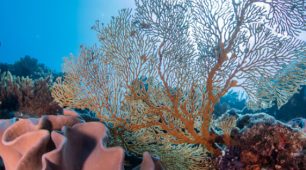
Most Great Barrier Reef angelfish feed on sponges, algae, and small invertebrates that grow within the coral structure. They’re closely associated with healthy, structurally complex reef environments and tend to be most abundant on outer reef walls and bommies with rich coral coverage.
Unlike some reef fish that school in large numbers, angelfish are typically solitary or found in bonded pairs. They’re territorial creatures and will often return to the same section of reef day after day, making them a rewarding species to observe on repeat dives.
Where to See Angelfish
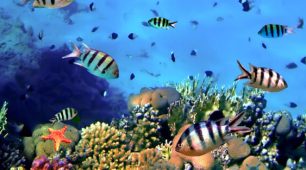
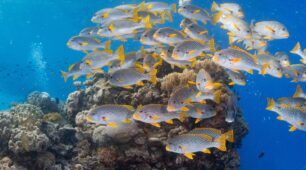
Angelfish are widespread throughout the Great Barrier Reef. They’re reliably spotted on outer reef systems such as Agincourt Reef near Port Douglas, Ribbon Reefs, and the coral bommies of the Whitsundays. Snorkellers and divers have good chances of encountering them on most full-day reef tours.

See them on a reef tour
Angelfish are commonly seen on outer reef snorkel and dive trips, though sightings are never guaranteed.



Photography Tips
Angelfish are not particularly shy, but they do move at their own pace. The best approach is to move slowly, stay at the fish’s level, and let it come to you. Avoid chasing or rushing them — patient observation is always rewarded with better encounters.


For more Great Barrier Reef fish guides, visit our Marine Life section.
A Hot Getaways destination. Where Care is Our Compass.
FAQs
How do you identify an angelfish?
Which angelfish live on the Great Barrier Reef?
Where can I see angelfish on the reef?
Do juvenile and adult angelfish look different?
How should I observe angelfish?
