

“Do not mistake boldness for aggression — the titan triggerfish simply knows exactly what belongs to it, and defends it accordingly.”
The Reef’s Most Fearless Resident: Meet the Titan Triggerfish
The titan triggerfish (Balistoides viridescens) is the largest triggerfish in the ocean and one of the most distinctive — and occasionally formidable — reef fish a snorkeller or diver will encounter on the Great Barrier Reef. With its angular body, vivid patterning, and a personality that manages to be both charismatic and assertive, the titan is a fish that leaves an impression. You might spot one yourself on a Reef Experience day tour, which visits outer reef sites where triggerfish are a common sight.


Identification
Titan triggerfish are unmistakable when you know what to look for. Adults grow to around 75 centimetres in length, with a deep, laterally compressed body covered in tough, plate-like scales. Their colouration is a striking mosaic of pale yellow, grey, green, and black — with darker edges to many scales giving a net-like appearance. The name “triggerfish” comes from the locking mechanism of the dorsal spine, which can be depressed only when a second “trigger” spine is released — an effective anti-predator adaptation.
Behaviour and Feeding
Titan triggerfish are active, diurnal feeders that work the reef with impressive persistence. They use their strong jaws and teeth — designed to crunch through hard coral — to excavate sand and rubble, exposing hidden invertebrates, urchins, and molluscs. Their feeding activity actually benefits the reef by turning over substrate and creating habitat for smaller species. They are often seen blowing jets of water into sandy areas to uncover prey.

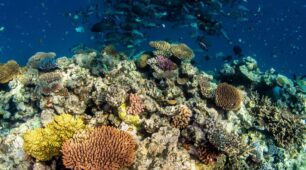


Quick Facts About the Titan Triggerfish
- Scientific name: Balistoides viridescens
- Also known as: Giant Triggerfish, Moustache Triggerfish, Blue-finned Triggerfish
- Found in: coral reefs, lagoons and reef slopes, from about 1 m to 50 m deep
- Diet: sea urchins, coral, crabs, molluscs and tube worms
- Size: up to 75 cm, the largest of all triggerfish
- Lifespan: not well documented
- Best chance of sighting: usually seen alone or in pairs on coral reefs
Scientific Classification
- Kingdom: Animalia
- Phylum: Chordata
- Class: Actinopterygii (ray-finned fishes)
- Order: Tetraodontiformes (pufferfishes, boxfishes and triggerfishes)
- Family: Balistidae (triggerfishes)
- Genus: Balistoides
- Species: Balistoides viridescens
- Conservation status: Least Concern (IUCN, 2022)
Common Names
- Primary common name: Titan Triggerfish
- Other names: Giant Triggerfish, Moustache Triggerfish, Blue-finned Triggerfish
Related Species
- Clown Triggerfish (Balistoides conspicillum)
- Yellowmargin Triggerfish (Pseudobalistes flavimarginatus)
Identification Notes
A large, heavily scaled triggerfish with a crosshatch pattern of dark-centred scales. Look for a dark band behind the mouth, a pale chin, a yellowish cheek and a yellow tail with a dark edge.
Role on the Reef
Titan triggerfish crunch through sea urchins, crabs, molluscs and coral with their strong teeth. They nest in coral rubble, and the females guard the nest during the breeding season, when they are known for charging and biting divers who come too close.
Learning about reef fish in class? We help schools, universities and study groups plan educational trips to the Great Barrier Reef. Depending on the program, groups can enjoy guided snorkelling and marine biology presentations.
Great Barrier Reef Educational Groups →
Nesting Behaviour and Why Divers Should Know It
During breeding season, female titan triggerfish excavate nest sites in sandy patches of the reef. They guard these nests with considerable vigour, defending the area around and above the nest. Any creature that enters this zone — including divers and snorkellers — may be charged or bitten. Experienced divers commonly advise swimming horizontally away from the nest rather than straight up. Their strong teeth can cause painful bites, so give nesting triggerfish plenty of room.
Ecological Role
Like most reef fish, the titan triggerfish contributes to ecosystem health through its feeding behaviour. By breaking up coral rubble, processing urchins, and turning over substrate, it creates microhabitats and makes nutrients available throughout the reef community. Its predatory pressure on sea urchins helps prevent the overgrazing of coral — making it, like so many reef species, an unlikely but important guardian of the system it inhabits.
A Hot Getaways destination. Where Care is Our Compass.
FAQs
How do you identify a titan triggerfish?
Are titan triggerfish dangerous?
How do I stay safe around a titan triggerfish?
Where do titan triggerfish live on the reef?
When is titan triggerfish breeding season?