
“The cleaner wrasse performs one of the reef’s most important services — and it does so with what looks remarkably like trust.”
Cleaner Wrasse – The Great Barrier Reef’s Essential Health Workers
The Bluestreak Cleaner Wrasse (Labroides dimidiatus) is one of the Great Barrier Reef’s most important and fascinating fish — not for its size (it rarely exceeds 12cm) but for its extraordinary role in maintaining the health of the entire reef ecosystem. Cleaner wrasse operate dedicated “cleaning stations” on the reef where other fish line up, often in large numbers, to have parasites, dead tissue, and food debris removed from their skin, gills, and even mouths.

Cleaning Stations – One of the Reef’s Great Natural Spectacles
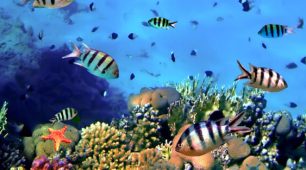
Cleaning stations are fixed locations on the reef — typically a specific coral head or prominent bommie — where fish of all species gather, often hovering in a distinctive “soliciting” posture with fins spread and heads up, waiting their turn to be cleaned.
The cleaner wrasse approaches even the most formidable reef predators — groupers, moray eels, large sharks — and works methodically over their surfaces, picking off parasites with precision. The fish being cleaned holds completely still and does not strike at the wrasse, even though it would normally eat a fish of that size. It’s one of the most striking examples of mutualism on the reef.
The interaction relies on the clear visual signals of the wrasse: its distinctive black stripe on a pale and blue body, and its showy, bobbing way of swimming. Fish from across a wide area of reef know these markings mean safety.

Quick Facts About the Cleaner Wrasse
- Scientific name: Labroides dimidiatus
- Also known as: Common Cleanerfish, Bluestreak Cleaner Wrasse
- Found in: coral reefs, from about 1 m to 40 m deep
- Diet: small parasites picked off other fish (mainly tiny crustaceans called gnathiid isopods), plus some fish mucus
- Size: up to about 12–14 cm
- Lifespan: up to about 4 years recorded
- Best chance of sighting: at cleaning stations, where larger fish queue to be cleaned
Scientific Classification
- Kingdom: Animalia
- Phylum: Chordata
- Class: Actinopterygii (ray-finned fishes)
- Order: Labriformes (formerly Perciformes)
- Family: Labridae (wrasses)
- Genus: Labroides
- Species: Labroides dimidiatus
- Conservation status: Least Concern (IUCN)
Common Names
- Primary common name: Common Cleanerfish
- Secondary common name: Bluestreak Cleaner Wrasse
- Other names: Cleaner Wrasse
Related Species
- Bicolor Cleanerfish (Labroides bicolor), northern Great Barrier Reef
- False Cleanerfish (Aspidontus taeniatus), not a wrasse but a blenny that mimics the cleaner so it can get close enough to bite other fish’s fins
Identification Notes
Adults have a pale head, a bluish rear and a broad black stripe along each side; juveniles are black with a bright blue stripe. The look-alike False Cleanerfish has its mouth underneath the snout, while the real cleaner’s mouth is at the tip.
Role on the Reef
Cleaner wrasse remove parasites from a huge number of reef fish every day. They live in groups of one dominant male with several females, and all start life as females. In a 2019 study, cleaner wrasse behaved in a way consistent with passing the mirror test, a classic test of self-recognition.
Learning about reef fish in class? We help schools, universities and study groups plan educational trips to the Great Barrier Reef. Depending on the program, groups can enjoy guided snorkelling and marine biology presentations.
Great Barrier Reef Educational Groups →
Why Cleaner Wrasse Matter
They are a small fish with a big job: at Lizard Island on the Great Barrier Reef, each cleaner wrasse was found to inspect about 2,300 fish a day and eat about 1,200 parasites a day (Grutter, 1996).
Watching a cleaning station is one of the highlights of any reef dive or snorkel — look for the telltale “queue” of fish hovering with an unusual stillness near prominent coral structures.
A Hot Getaways destination. Where Care is Our Compass.
FAQs
What is a cleaner wrasse?
What is a cleaning station?
Do big fish eat cleaner wrasse?
Where can I see cleaner wrasse on the Great Barrier Reef?
How should I behave near a cleaning station?