
“The butterflyfish flickers through the coral like a living jewel — patterned, purposeful, and utterly at home in the reef’s complexity.”
Butterflyfish of the Great Barrier Reef – The Reef’s Most Colourful Reef Residents
Butterflyfish are among the most diverse and visually striking fish families on the Great Barrier Reef. With more than 60 species recorded in Australian waters, they represent an extraordinary spectrum of colour patterns, body shapes, and behaviours — and no two species look quite alike.


About Butterflyfish
Butterflyfish belong to the family Chaetodontidae and are found on coral reefs throughout the tropical Indo-Pacific. They’re closely associated with live coral — many species feed exclusively on coral polyps or the small organisms that live within coral structures — so many species decline when coral is lost.
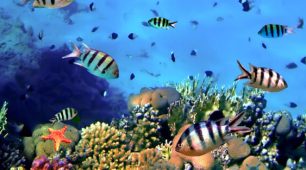
Most butterflyfish species display striking colour patterns that serve as camouflage, species recognition, and anti-predator strategies. Many have a dark eyespot near the tail thought to confuse predators about which end is which.
Common species on the Great Barrier Reef include the Chevron Butterflyfish, Raccoon Butterflyfish, Threadfin Butterflyfish, and Rainford’s Butterflyfish. Each occupies slightly different reef microhabitats and feeds on different prey.


Quick Facts About Butterflyfish
- Scientific name: family Chaetodontidae (most reef species are in the genus Chaetodon)
- Also known as: coralfishes
- Found in: coral reefs, lagoons and outer reef slopes
- Diet: many eat coral polyps and small invertebrates; some eat only live coral, and others feed on plankton
- Size: most common reef species reach 15–23 cm
- Lifespan: not well documented for most species
- Best chance of sighting: shallow, coral-rich reefs during the day, often in pairs
Scientific Classification
- Kingdom: Animalia
- Phylum: Chordata
- Class: Actinopterygii (ray-finned fishes)
- Order: Acanthuriformes (formerly Perciformes)
- Family: Chaetodontidae (butterflyfishes)
- Conservation status: most reef species are Least Concern; the Chevron and Rainford’s Butterflyfish are listed as Near Threatened (IUCN, 2009)
Common Names
- Primary common name: Butterflyfish
- Other names: coralfish
Related Species
- Chevron Butterflyfish (Chaetodon trifascialis)
- Racoon Butterflyfish (Chaetodon lunula)
- Rainford’s Butterflyfish (Chaetodon rainfordi)
- Pinstripe Butterflyfish (Chaetodon lunulatus)
- Threadfin Butterflyfish (Chaetodon auriga)
- The closest related family is the angelfishes (Pomacanthidae)
Identification Notes
Butterflyfish have thin, flat, disc-shaped bodies, and many have a dark band through the eye. They look a lot like angelfish, but angelfish are sturdier and have a sharp spine on the cheek, which butterflyfish do not have.
Role on the Reef
Several common reef species, including the Chevron, Pinstripe and Rainford’s Butterflyfish, eat only live coral. A study at Trunk Reef on the central Great Barrier Reef found these coral-eating species declined sharply after coral cover fell, so they are closely tied to healthy coral (Pratchett et al., 2006).
Learning about reef fish in class? We help schools, universities and study groups plan educational trips to the Great Barrier Reef. Depending on the program, groups can enjoy guided snorkelling and marine biology presentations.
Great Barrier Reef Educational Groups →
Behaviour and Ecology
Many butterflyfish species are often seen in pairs. They’re territorial within their home reef area and can often be observed patrolling the same section of reef on successive dives or snorkels.
Because many species depend on healthy coral for food, butterflyfish populations often decline when coral is lost, so falling numbers can be an early sign of coral damage.
Where to See Butterflyfish
Butterflyfish are abundant throughout the Great Barrier Reef on any healthy coral reef system. They’re among the first fish snorkellers notice due to their vivid colouring and relatively slow, approachable swimming style.
A Hot Getaways destination. Where Care is Our Compass.
FAQs
What are butterflyfish?
How do you identify a butterflyfish?
Where can I see butterflyfish on the Great Barrier Reef?
What do butterflyfish eat?
How should I observe butterflyfish?