
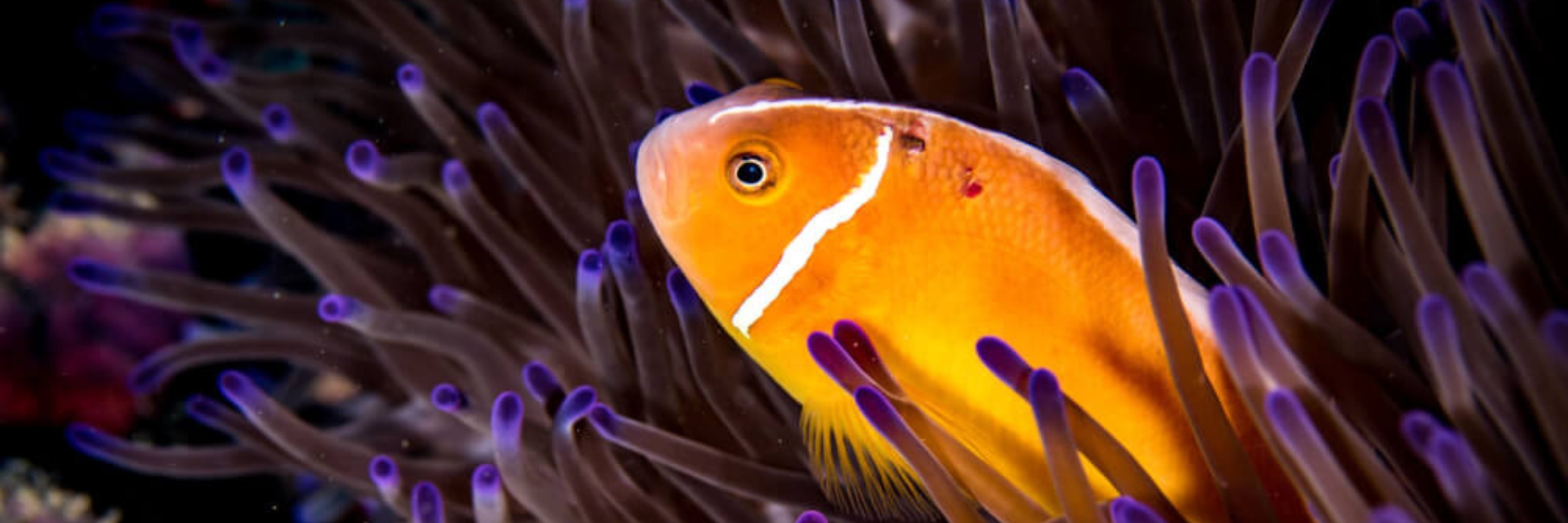
“That flash of orange and white darting into the anemone — this is what people travel halfway around the world to see.”
Anemonefish of the Great Barrier Reef – More Than Just a Famous Fish
Anemonefish — often called clownfish — are among the most iconic and beloved residents of the Great Barrier Reef. Their vivid colouring and their extraordinary relationship with sea anemones make them one of the reef’s most fascinating stories, and one of the first things snorkellers look for when they enter the water.


About Anemonefish
There are around 30 known species of anemonefish, and several call the Great Barrier Reef home. Species you may see here include the Barrier Reef Anemonefish, the orange and white Eastern Clown Anemonefish (a close relative of the Finding Nemo clownfish), Clark’s Anemonefish, the Pink Anemonefish and the dark Blackback Anemonefish.
Anemonefish live in an extraordinary symbiotic relationship with their host sea anemone. A special mucus coating on their skin protects them from the anemone’s stinging cells, allowing them to shelter within the tentacles while the anemone benefits from their cleaning and defensive behaviours. It’s one of nature’s most elegant partnerships.
What many visitors don’t know is that anemonefish mature as males. When the dominant female in a group dies, the largest male changes sex to become female. It’s a remarkable piece of reef biology.


Quick Facts About Anemonefish
- Scientific name: genus Amphiprion (damselfish family, Pomacentridae)
- Also known as: clownfish
- Found in: living among the tentacles of host sea anemones on coral reefs, mostly from about 1 m to 25 m deep
- Diet: tiny plankton such as copepods, plus algae
- Size: about 10–17 cm, depending on the species
- Lifespan: not well documented for most species
- Best chance of sighting: shallow reefs and lagoons with host anemones, such as bubble-tip and carpet anemones
Scientific Classification
- Kingdom: Animalia
- Phylum: Chordata
- Class: Actinopterygii (ray-finned fishes)
- Order: Perciformes (some current classifications place damselfishes in a different group)
- Family: Pomacentridae (damselfishes)
- Genus: Amphiprion
- Conservation status: the reef species assessed are Least Concern (IUCN)
Common Names
- Primary common name: Anemonefish
- Other names: clownfish
Anemonefish of the Great Barrier Reef
- Barrier Reef Anemonefish (Amphiprion akindynos)
- Eastern Clown Anemonefish, also called Orange Clownfish (Amphiprion percula)
- Clark’s Anemonefish (Amphiprion clarkii)
- Pink Anemonefish (Amphiprion perideraion)
- Blackback Anemonefish (Amphiprion melanopus)
- Orangefin Anemonefish (Amphiprion chrysopterus)
- Spinecheek Anemonefish (Amphiprion biaculeatus)
- Saddleback Anemonefish (Amphiprion polymnus), on inshore reefs
Identification Notes
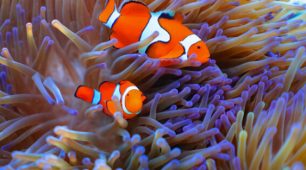
The Barrier Reef Anemonefish is orange to orange-brown with two black-edged white bars and a white tail. The Eastern Clown Anemonefish is bright orange with three white bars edged in thick black. The Finding Nemo clownfish looks very similar but usually has thinner or no black edging, and it is not found on the Great Barrier Reef.
Role on the Reef
Anemonefish and their host anemones help each other: the anemone protects the fish from predators, and the fish’s waste helps feed the tiny algae living inside the anemone. A protective mucus coating stops the fish from being stung. Each group is led by a breeding pair, and the largest fish is the female; if she dies, the largest male changes sex to replace her.
Learning about reef fish in class? We help schools, universities and study groups plan educational trips to the Great Barrier Reef. Depending on the program, groups can enjoy guided snorkelling and marine biology presentations.
Great Barrier Reef Educational Groups →
Where to See Anemonefish on the Great Barrier Reef
Anemonefish are widespread throughout the Great Barrier Reef, particularly on shallow coral gardens and fringing reefs. They’re one of the most reliably spotted reef fish on any snorkel tour from Cairns or Port Douglas.
Look for bubble-tip anemones and carpet anemones in shallow, well-lit sections of coral reef — the anemonefish won’t be far away.
For more reef fish guides, visit our Marine Life of the Great Barrier Reef section.
A Hot Getaways destination. Where Care is Our Compass.
FAQs
Is anemonefish the same as clownfish?
Why do anemonefish live in sea anemones?
Where can I see anemonefish on the Great Barrier Reef?
Is anemonefish the fish from Finding Nemo?
How should I behave around anemonefish?
