
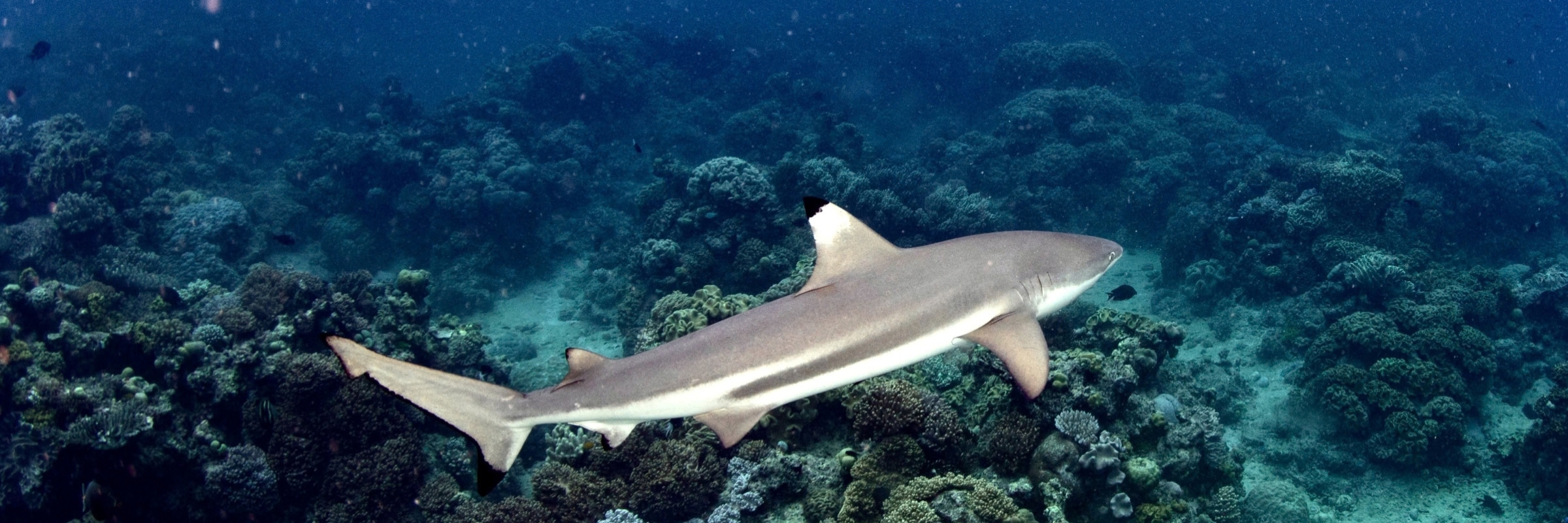
“The blacktip cuts a perfect arc through the shallow water, those dark fin tips unmistakable — ancient, unhurried, entirely at home.”
Blacktip Reef Shark – The Most Recognisable Shark on the Great Barrier Reef
The Blacktip Reef Shark (Carcharhinus melanopterus) is one of the most commonly encountered sharks on the Great Barrier Reef, and one of the most unmistakable. Its black-tipped dorsal and caudal fins give it a distinctive appearance that makes identification immediate — even for first-time reef visitors.


About the Blacktip Reef Shark
Blacktip Reef Sharks are a slender, medium-sized shark species growing to about 1.8 metres, though most seen on the reef are smaller. They prefer shallow reef environments — particularly reef flats, lagoons, and the inner edges of coral reefs — where they hunt small reef fish, crustaceans, and cephalopods.
They’re highly social sharks and are frequently seen in groups, patrolling the shallows in a characteristic slow, sinuous pattern. Their preference for shallow water makes them one of the most visible shark species on the reef and a common sight on snorkelling tours, particularly in areas with clear, calm conditions.
Are Blacktip Reef Sharks Dangerous?
Blacktip Reef Sharks are not usually dangerous to humans, but they may nip at the feet of people wading in shallow water. They are curious but cautious, and interactions with snorkellers and divers are typically calm. There have been very few documented incidents involving Blacktip Reef Sharks and humans, and these have almost always involved provocation, speared fish or people wading in shallow water. When wading on reef flats, shuffle your feet and give any shark space.
Snorkellers who encounter Blacktip Reef Sharks on the Great Barrier Reef are advised to remain calm, avoid sudden movements, and simply observe. The experience of watching a Blacktip patrol the reef is one of the highlights of any reef visit.

Quick Facts About the Blacktip Reef Shark
- Scientific name: Carcharhinus melanopterus
- Not to be confused with: the larger common blacktip and Australian blacktip sharks
- Found in: shallow reef flats, lagoons and around coral cays, usually in less than 40 m
- Diet: small fish, squid, octopus and crustaceans
- Size: up to about 1.8 m; mature at about 1 m
- Lifespan: about 15 years in the wild
- Best chance of sighting: snorkelling over shallow reef flats and around islands and cays
Scientific Classification
- Kingdom: Animalia
- Phylum: Chordata
- Class: Chondrichthyes (sharks and rays)
- Order: Carcharhiniformes
- Family: Carcharhinidae (whaler sharks)
- Genus: Carcharhinus
- Species: Carcharhinus melanopterus
- Conservation status: Vulnerable (IUCN, 2020); Least Concern in Australia, where marine parks provide important refuge; listed on CITES Appendix II
Identification Notes
Bold black tips on all fins, especially the first dorsal fin, where the black tip is edged with a white band. Yellowish-brown above and white below, with a pale stripe along each side.
Related Species
Other whaler sharks seen on the Great Barrier Reef include the whitetip reef shark and the grey reef shark.
Learning about reef animals in class? We help schools, universities and study groups plan educational trips to the Great Barrier Reef. Depending on the program, groups can enjoy guided snorkelling and marine biology presentations.
Great Barrier Reef Educational Groups →
Where to See Blacktip Reef Sharks
Blacktip Reef Sharks are widespread across the Great Barrier Reef. They’re particularly common on shallow reef flats, in the shallow waters around coral cays, and near the edges of lagoons at islands like Low Isles (Port Douglas), Green Island (Cairns), and throughout the Whitsundays. You can spot them yourself on a Reef Experience day tour from Cairns.
A Hot Getaways destination. Where Care is Our Compass.
See them on a reef tour
Reef sharks, rays and colourful reef fish are often seen on outer reef snorkel and dive trips, though sightings are never guaranteed.


FAQs
How do I identify a blacktip reef shark?
Where do blacktip reef sharks live?
Are blacktip reef sharks dangerous to snorkellers?
Are blacktip reef sharks common on the Great Barrier Reef?
What should I do if I see a blacktip reef shark while snorkelling?
