

“The whitetip reef shark rests in plain sight — unhurried and untroubled — an expression of reef life at its most confident.”
At Home on the Reef: The Whitetip Reef Shark
The whitetip reef shark (Triaenodon obesus) is one of the most frequently encountered sharks at the Great Barrier Reef and one of the most charismatic. Distinctive for the bright white tips on its dorsal and caudal fins, the whitetip is a medium-sized, slender shark that inhabits the reef with a calm self-assurance that is immediately apparent. Divers and snorkellers regularly find these sharks resting motionless on the sandy bottom beneath coral outcrops — apparently asleep, entirely at ease, and utterly unconcerned by human presence.


Identification
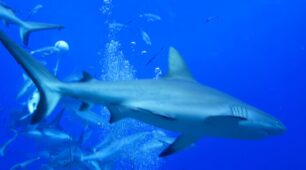
Whitetip reef sharks are immediately recognisable by the white-tipped first dorsal fin and the white tip on the upper lobe of the tail — markings shared to some extent with the oceanic whitetip, though that is a much larger, open-ocean species unlikely to be encountered on a reef day tour. The whitetip reef shark’s body is slender and somewhat flattened, with a short, blunt snout. Adults rarely grow longer than about 1.6 metres. Colouration is grey-brown on top with a pale underside, and the skin has a slightly roughened texture visible at close range.
Behaviour
Whitetip reef sharks are one of the few shark species capable of resting on the seafloor because they can pump water over their gills without swimming — unlike many shark species that must keep moving to breathe. During the day, they frequently rest in groups in sheltered areas under coral ledges or in reef caves. At night, they become active hunters, pursuing fish through the reef structure with remarkable agility — their slender bodies allow them to follow prey into reef crevices that larger sharks cannot access.

Encounters at the Great Barrier Reef
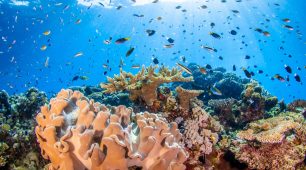
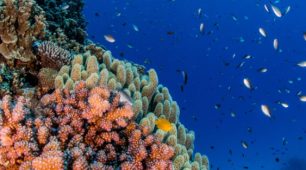
Whitetip reef sharks are among the most commonly sighted sharks on Great Barrier Reef day tours and liveaboard expeditions. They are frequently seen resting on the sandy bottom near coral bommies, or swimming slowly along reef walls and through coral gardens. Snorkellers who move slowly and maintain a respectful distance will often observe these sharks at very close range without disturbing them. They are not aggressive toward divers under normal circumstances, and incidents involving whitetip reef sharks are exceptionally rare and usually involve speared fish. You can see them for yourself on a Reef Experience day tour from Cairns.



Ecological Role
As reef predators, whitetip reef sharks help maintain the health and balance of the fish community they inhabit. By hunting at night through the reef’s complex structure, they exert predatory pressure on smaller reef fish and invertebrates, contributing to the natural regulation of reef populations. Their presence is generally a sign of a healthy, undisturbed reef environment.

Quick Facts About the Whitetip Reef Shark
- Scientific name: Triaenodon obesus
- Not to be confused with: the oceanic whitetip shark, a different, open-ocean species
- Found in: clear coral reefs, resting by day in caves, under ledges or on sand, usually 8–40 m deep
- Diet: mainly fish, plus octopus, crabs and lobsters, often chased into reef crevices
- Size: rarely over about 1.6 m
- Lifespan: about 16 years, with up to 25 reported
- Best chance of sighting: resting under ledges on outer reef dives by day
Scientific Classification
- Kingdom: Animalia
- Phylum: Chordata
- Class: Chondrichthyes (sharks and rays)
- Order: Carcharhiniformes
- Family: Carcharhinidae (whaler sharks)
- Genus: Triaenodon
- Species: Triaenodon obesus
- Conservation status: Vulnerable (IUCN, 2020); Near Threatened in Australia
Related Species
Other whaler sharks seen on the Great Barrier Reef include the blacktip reef shark and the grey reef shark.
Learning about reef animals in class? We help schools, universities and study groups plan educational trips to the Great Barrier Reef. Depending on the program, groups can enjoy guided snorkelling and marine biology presentations.
Great Barrier Reef Educational Groups →
Conservation Status
The whitetip reef shark is listed as Vulnerable on the IUCN Red List (2020). Populations have declined in many parts of its range due to fishing pressure — both targeted and as bycatch — and habitat degradation. In the Great Barrier Reef Marine Park, whitetip reef sharks are protected from fishing in green zones, and Queensland rules limit how many can be kept elsewhere. Surveys have found far more of them in no-fishing zones than in fished areas, which shows how important marine park zoning is for this shark. Reef tourism that operates responsibly plays a role in the conservation case for protecting shark populations in marine parks.


A Hot Getaways destination. Where Care is Our Compass.
FAQs
How do I identify a whitetip reef shark?
Why do whitetip reef sharks lie still on the bottom?
Are whitetip reef sharks dangerous to divers?
Are whitetip reef sharks common on the Great Barrier Reef?
What should I do if I see a whitetip reef shark?