

“Swimming beside a whale shark is not just an encounter with a fish — it is a conversation with the ocean’s oldest living patience.”
The Gentle Giant: Whale Sharks of the Great Barrier Reef
The whale shark (Rhincodon typus) is the largest fish in the ocean — a filter-feeding giant that can reach 12 metres or more in length and live for at least 50 years, possibly much longer. Despite its imposing dimensions, the whale shark is no danger to people as a predator, feeding on plankton, small fish, and fish eggs filtered through a wide, flat mouth that sits at the front of an enormous, slightly flattened head. Swimming alongside a whale shark is one of the most extraordinary wildlife encounters available anywhere in the world. A Reef Experience day tour from Cairns visits the outer reef, where whale sharks are occasionally seen in season.


Identification
Whale sharks are impossible to confuse with any other species. Their immense size is the first indicator, but their colouration is equally distinctive — a blue-grey or grey-brown body covered in a pale pattern of white spots and stripes that is unique to each individual, like a fingerprint. This patterning is used by researchers to identify individuals using photographic records, and citizen science programs allow visitors who photograph whale sharks to contribute their images to population databases.
Behaviour and Feeding
Whale sharks are filter feeders — among the most efficient in the ocean. They swim slowly at or near the surface with their mouths open, filtering enormous volumes of water to collect concentrations of plankton, fish eggs, and small fish. Their mouths are up to 1.5 metres wide and contain hundreds of tiny teeth arranged on multiple rows, but these teeth play no role in feeding — food simply filters through modified gill rakers. The whale shark’s feeding behaviour is often predictable during known aggregation events, making them accessible to snorkellers and researchers alike.
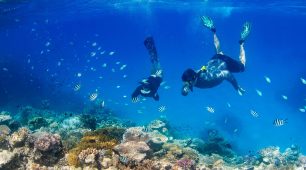



Whale Shark Encounters at the Great Barrier Reef
Whale sharks are sighted at the Great Barrier Reef, at any time of year, with most sightings in November and December and recent sightings clustered off Townsville and in the Far North. Encounters are opportunistic rather than guaranteed — unlike Ningaloo Reef in Western Australia, which hosts a predictable seasonal aggregation of whale sharks, Great Barrier Reef sightings tend to be unscheduled encounters during reef day tours or liveaboard expeditions. Researchers and tour operators have developed reporting systems that allow word of a whale shark sighting to spread quickly, enabling vessels in the area to offer their guests a swim.
Quick Facts About the Whale Shark
- Scientific name: Rhincodon typus
- Found in: open water over and beyond the reef; usually in the top 100 m, though tagged whale sharks have dived below 1,900 m
- Diet: plankton (including krill), fish eggs and small fish, filtered through the gills
- Size: usually up to about 12 m, with a few reports of larger sharks
- Lifespan: at least 50 years, the oldest age confirmed so far
- Best chance of sighting: possible year-round, with most sightings in November and December; never guaranteed on any tour
Scientific Classification
- Kingdom: Animalia
- Phylum: Chordata
- Class: Chondrichthyes (sharks and rays)
- Order: Orectolobiformes (carpet sharks)
- Family: Rhincodontidae (the only species in its family)
- Genus: Rhincodon
- Species: Rhincodon typus
- Conservation status: Endangered (IUCN); Vulnerable and Migratory under the EPBC Act; listed on CITES Appendix II
Related Species
The whale shark is a carpet shark. Its relatives on the Great Barrier Reef include the wobbegongs and the epaulette shark.
Identification Notes
A huge, broad, flat-headed shark with a wide mouth at the very front of its head, and dark blue-grey to brown skin covered in pale spots and stripes. Each whale shark’s spot pattern is unique, so researchers can identify individuals from photos.
Learning about reef animals in class? We help schools, universities and study groups plan educational trips to the Great Barrier Reef. Depending on the program, groups can enjoy guided snorkelling and marine biology presentations.
Great Barrier Reef Educational Groups →
Conservation Status and Threats
The whale shark is classified as Endangered on the IUCN Red List, a status it has held since 2016. Despite their size, whale sharks are vulnerable to boat strikes, entanglement in fishing gear, and targeted hunting in some parts of their range. Their slow reproductive rate — females give birth to live young, but much about how often they breed is still unknown — makes population recovery from losses extremely slow. Within Australian waters, whale sharks are listed as Vulnerable and Migratory under the Environment Protection and Biodiversity Conservation Act 1999. They are also listed under international conservation agreements including CITES.
A Hot Getaways destination. Where Care is Our Compass.
FAQs
How big do whale sharks get?
Are whale sharks dangerous to humans?
Can you swim with whale sharks on the Great Barrier Reef?
How do you identify a whale shark?
When are whale sharks most likely to be seen?