
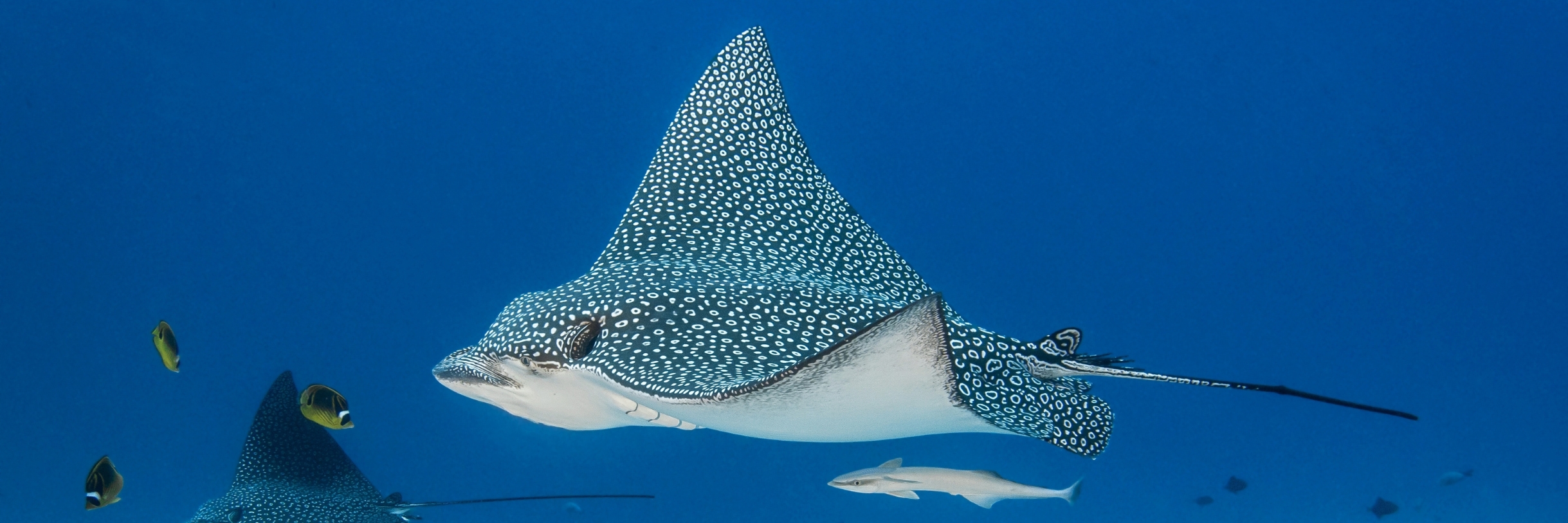
“The eagle ray passes beneath the boat like a shadow with wings, spinning in slow spirals through the clear water.”
Eagle Rays of the Great Barrier Reef – Graceful Flyers of the Reef
Eagle rays are among the most graceful and striking animals encountered on the Great Barrier Reef. With their distinctive diamond-shaped bodies, pointed snouts, and long whip-like tails, they cruise through the water with effortless, wing-like undulations that give them an otherworldly quality.


About Eagle Rays
Eagle Ray Taxonomy
Eagle rays belong to a fascinating group of cartilaginous fish closely related to sharks and other rays. Like sharks, their skeletons are made from cartilage rather than bone, giving them flexibility and strength as they glide through the ocean.
Scientists classify eagle rays within the Myliobatidae family, which includes several species found in tropical and subtropical oceans, including the waters of the Great Barrier Reef.
-
- Scientific Classification of Eagle Rays
- Kingdom: Animalia
- Phylum: Chordata
- Class: Chondrichthyes (cartilaginous fish – sharks and rays)
- Subclass: Elasmobranchii
- Order: Myliobatiformes
- Family: Myliobatidae
- Genus: Aetobatus
- Species: Aetobatus ocellatus (whitespotted eagle ray)
- Common Group: Eagle Rays
- Conservation Status: Vulnerable worldwide (IUCN Red List); Least Concern in Australia
One of the most recognisable species seen on the Great Barrier Reef is the Whitespotted Eagle Ray (Aetobatus ocellatus), also called the spotted eagle ray, known for its striking white spots and long whip-like tail.
These rays are powerful swimmers and can travel long distances across reefs, lagoons and open ocean.
Quick Facts About Eagle Rays
- Common Name: Eagle Ray
- Scientific Family: Myliobatidae
- Size: Disc width up to about 3 metres (whitespotted eagle ray)
- Diet: Mainly snails, clams and crabs, crushed with plate-like teeth; also worms, octopus and small fish
- Habitat: Coral reefs, sandy lagoons and coastal waters
- Lifespan: Thought to be around 19 years (an estimate based on a closely related species)
- Conservation Status: Vulnerable worldwide (IUCN Red List); Least Concern in Australia
- Found On The Reef: Often seen gliding gracefully over sandy seabeds or reef edges
- Special Feature: Distinctive “wing-like” fins that make them appear to fly underwater
About Eagle Rays
Few sights on the Great Barrier Reef are as graceful as an eagle ray gliding effortlessly through the water. With wide triangular fins that resemble wings, these magnificent rays appear to “fly” through the ocean as they cruise over coral reefs, lagoons and sandy seabeds.
They are powerful yet peaceful marine animals that capture the imagination of snorkellers and divers alike. When one passes beneath you on the reef, moving smoothly and silently through the blue water, it often becomes one of the most memorable wildlife encounters of the day.
What Do Eagle Rays Look Like?
They are easily recognised by their broad diamond-shaped bodies and long, whip-like tails. Their large pectoral fins move in slow, powerful strokes, allowing them to glide through the water with incredible elegance.
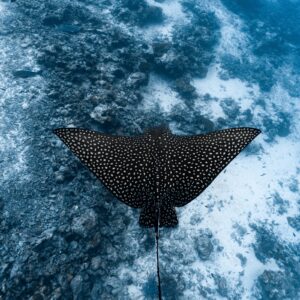
Many species also have beautiful spotted patterns across their backs, which help them blend into the dappled sunlight above the reef.
Key features include:
-
- Long triangular “wings” used for graceful swimming
- A pointed snout designed to dig into sand for food
- A long whip-like tail with one or more venomous spines near its base
- Smooth skin and often distinctive white spots or markings
Their movement is so fluid that they appear almost bird-like as they pass through the ocean.
Where Can You See Eagle Rays?
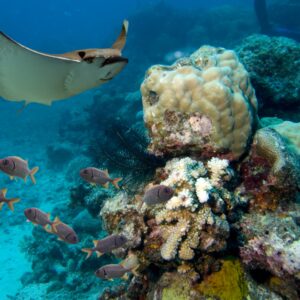
On the Great Barrier Reef, eagle rays are often seen in areas with sandy bottoms or near coral bommies where food is plentiful.
You may spot them:
-
- Gliding over reef flats
- Cruising along sandy lagoons
- Passing beneath snorkellers in deeper reef channels
- Swimming near drop-offs on the outer reef
Because they are naturally curious yet cautious animals, eagle rays usually keep a respectful distance from divers. However, if you remain calm and still in the water, they may glide past surprisingly close.
What Do Eagle Rays Eat?
Eagle rays are skilled hunters that feed mainly on animals living in the sand. Using their specialised snouts and powerful jaws, they search the seabed for hidden prey.
Their diet includes:
-
- Crabs
- Clams and molluscs
- Shrimp
- Small fish
- Sea worms
Once they locate food buried in the sand, eagle rays use their snout to dig and their crushing plates to break open hard shells.
Fish and Marine Life Seen With Eagle Rays
Eagle rays are often seen travelling through reef environments where many other fish species gather. While they do not form permanent partnerships with other fish, several species are commonly seen swimming nearby.
This happens because eagle rays disturb the sandy seabed while searching for food, which exposes small creatures that other fish quickly take advantage of.
Fish and marine animals frequently seen near eagle rays on the Great Barrier Reef include:
-
- Trevally – fast-moving reef predators that follow rays looking for disturbed prey
- Remora (Suckerfish) – sometimes attach themselves to larger marine animals for protection and food scraps
- Goatfish – bottom-feeding fish that benefit when rays stir up the sand
- Wrasse – curious reef fish often seen inspecting the seabed near rays
- Batfish – occasionally seen swimming near larger rays in reef lagoons
- Reef Sharks – occasionally share the same sandy feeding grounds
- Snappers and Emperor Fish – opportunistic feeders that move in when the seabed is disturbed
For snorkellers and divers, watching this interaction can feel like witnessing a small reef ecosystem in motion, with the eagle ray acting as the centre of activity.
Are they Dangerous?
Eagle rays are not aggressive and pose very little danger to humans.
Whitespotted eagle rays have one or more venomous spines near the base of the tail. They rarely use them unless threatened and usually glide away if approached, but a spine can cause a painful wound, so never touch, chase or corner one.
For snorkellers and divers, they are a beautiful and peaceful animal to observe. As always on the reef, the best practice is to watch marine life respectfully without touching or chasing it.
A Magical Moment on the Reef
Seeing an eagle ray is often described as one of the most magical moments on the Great Barrier Reef. Their effortless movement through the water reminds visitors just how extraordinary reef wildlife can be.
If you’re hoping to see one for yourself, a Reef Experience day tour from Cairns visits the outer reef, where eagle rays are sometimes seen over sandy areas and reef edges. If you are lucky enough to encounter one while snorkelling or diving, take a moment to simply watch as it glides through the ocean, a true symbol of the reef’s beauty and wonder.
Learning about reef animals in class? We help schools, universities and study groups plan educational trips to the Great Barrier Reef. Depending on the program, groups can enjoy guided snorkelling and marine biology presentations.
Great Barrier Reef Educational Groups →
FAQs
Are eagle rays common on the Great Barrier Reef?
How big do eagle rays grow?
Can eagle rays sting?
Do eagle rays swim alone or in groups?
What is the difference between an eagle ray and a manta ray?
Eagle Rays – Graceful Flyers of the Reef
Eagle rays are one of the most elegant animals you can encounter on the Great Barrier Reef. With their wide wings, graceful movement and calm nature, they seem to glide through the ocean as if they are flying underwater.
For many snorkellers and divers, spotting an eagle ray becomes one of those unforgettable reef moments, a peaceful encounter with one of the ocean’s most beautiful creatures.
Whether you see one cruising over a sandy lagoon, gliding past coral bommies, or swimming quietly beneath your snorkel mask, eagle rays remind us just how special the Great Barrier Reef truly is.
If you’re planning a reef tour from Cairns or Port Douglas, keep your eyes open, you may be lucky enough to witness these magnificent rays soaring through the blue waters of the reef.
Discover the Great Barrier Reef Animals


A Hot Getaways destination. Where Care is Our Compass.
