

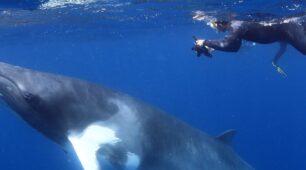
“Each winter, mainly in June and July, dwarf minke whales visit the Ribbon Reefs and approach snorkellers in the water with a curiosity that leaves people speechless.”
Minke Whales of the Great Barrier Reef – One of the World’s Most Unique Wildlife Encounters
Explore the Great Barrier Reef Marine Mammals
Minke Whale: Discovering These Gentle Giants on the Great Barrier Reef
Minke Whale
- Smallest Baleen Whale: Minke whales are among the smallest baleen whales, making them a unique and approachable sight for marine enthusiasts exploring Australian waters.
- Distinctive Appearance: easily recognisable during whale-watching tours due to their sleek, streamlined bodies and subtle black-and-white markings.
- Seasonal Migrators: They travel vast ocean distances, with seasonal migrations bringing them into Australian waters as they follow rich feeding grounds.
- Playful and Curious: Minke whales are known for their gentle and curious nature. They often approach boats, offering thrilling and intimate encounters.
- Filter Feeders: These whales use their baleen plates to filter small fish, krill, and plankton, which is vital in maintaining the marine ecosystem’s balance.
- Agile Swimmers: Despite their size, minke whales are remarkably fast and agile in the water, adding excitement to any ocean adventure.
- Conservation Ambassadors: Spotting these magnificent creatures highlights the importance of marine conservation efforts, encouraging visitors to support sustainable practices that protect our ocean habitats.
Discover the Minke Whale
Minke whales are among the magnificent marine creatures that grace the waters of the Great Barrier Reef. Adding to its allure as a world-renowned natural wonder. In this article, we’ll delve into the fascinating world of minke whales, exploring their characteristics, behaviours, and unique role in this diverse marine ecosystem.
Quick Facts About the Dwarf Minke Whale
- Scientific name: Balaenoptera acutorostrata (the dwarf minke is an unnamed subspecies)
- Also known as: dwarf minke; not to be confused with the Antarctic minke whale (Balaenoptera bonaerensis)
- Found in: Southern Hemisphere waters; on the Great Barrier Reef mostly the northern reef, especially the Ribbon Reefs north of Port Douglas
- Size: up to about 8 m; calves about 2 m at birth
- Best chance of sighting: June and July on the northern Great Barrier Reef; sightings are never guaranteed
Scientific Classification
- Kingdom: Animalia
- Phylum: Chordata
- Class: Mammalia
- Order: Artiodactyla (whales and dolphins, infraorder Cetacea)
- Family: Balaenopteridae (rorquals)
- Genus: Balaenoptera
- Species: Balaenoptera acutorostrata (dwarf form)
- Conservation status: common minke whale Least Concern globally (IUCN, 2018); not listed as threatened in Australia, and protected in Australian waters
Planning to get in the water? Read our guide to swimming with dwarf minke whales.
Learning about reef animals in class? We help schools, universities and study groups plan educational trips to the Great Barrier Reef. Depending on the program, groups can enjoy guided snorkelling and marine biology presentations.
Great Barrier Reef Educational Groups →
Meet the Minke Whales
Minke whales are relatively small members of the baleen family, characterised by their streamlined bodies and distinctive, narrow, and pointed rostrums. These whales are famous for their gentle and curious nature, and they frequently approach boats and divers without posing any threat.
Species Diversity
In the waters of the Great Barrier Reef, the minke whale you are most likely to meet is the dwarf minke whale, an unnamed subspecies of the common minke whale (Balaenoptera acutorostrata). The larger Antarctic minke whale (Balaenoptera bonaerensis) is a separate species. These whales differ in size, habitat, and migratory patterns.
Seasonal Visitors
During the Australian winter months, mainly in June and July, dwarf minke whales visit the northern Great Barrier Reef in search of warmer waters. This annual migration provides a unique opportunity for divers and researchers to encounter these majestic creatures.
Curious Encounters
One of the remarkable aspects is their curiosity towards humans. When approached respectfully and cautiously, they often display playful and inquisitive behaviours, such as breaching, spy-hopping, and swimming close to boats and divers. This makes them a favourite among wildlife enthusiasts and photographers.
Feeding Habits
Minke whales are filter feeders, primarily consuming small fish and krill by taking in large mouthfuls of water and filtering out their prey through their baleen plates. The nutrient-rich waters of the Great Barrier Reef provide ample food sources for these whales during their visits.
Minke Whale Conservation and Research
The common minke whale, which includes the dwarf minke, is listed as Least Concern by the International Union for Conservation of Nature (IUCN) (2018). The Antarctic minke whale is listed as Near Threatened. All whales are protected in Australian waters. However, ongoing research and conservation efforts are essential to monitor their populations and understand their ecological significance within the Great Barrier Reef’s ecosystem.
Whale-Watching Adventures
The Great Barrier Reef offers a range of whale-watching tours and expeditions for those seeking the thrill of encountering minke whales in their natural habitat. These guided experiences provide a safe and educational way to witness the beauty and grace of these gentle giants up close.
Preserving the Wonder
As with all marine life in the Great Barrier Reef, the conservation and protection of minke whales and their habitat are paramount. Efforts to reduce human impact, such as responsible boating and diving practices, are crucial to ensuring the continued well-being of these remarkable creatures and the entire reef.
Diet, Behaviour, and Where to See Them in Australia
Spot these fascinating creatures on the Great Barrier Reef, one of Australia’s natural wonders. These gentle giants are a captivating attraction for visitors exploring the reef’s beauty.

Reproduction
Minke whales, like many marine mammals, have a fascinating reproductive process.
Let’s explore the fascinating topic of minke whale reproduction.
Minke whales grace the waters of the Coral Sea off the northeastern coast of Australia. Their remarkable reproductive cycle adds to the allure of encountering these gentle giants in their natural habitat.
Like many baleen whales, minke whales follow a distinctive reproductive pattern. They are known as seasonal breeders, meaning they mate and calve during specific times of the year. Dwarf minke whales visit the northern Great Barrier Reef mainly in June and July.
Courtship
During this period, males compete for the attention of female mates. Dwarf minke whales make a distinctive mechanical-sounding call, sometimes called the “Star Wars” sound, although its purpose is not fully known. Witnessing these majestic creatures court one another is a captivating spectacle.
Once a female chooses a mate, they engage in a ritualised courtship that can include synchronised swimming and vocalisations. Mating takes place, and the female becomes pregnant. Pregnancy lasts about 10 months.

Minke whale calves
Where dwarf minke whales give birth is still not well known, although young calves have been seen on the northern Great Barrier Reef. Calves are about 2 metres long at birth. Mother and calf share a strong bond, and the mother provides nourishment and protection to her offspring.
Mothers are known to be attentive and protective, often keeping their calves close by. It’s a heartwarming sight to witness as these young whales learn essential life skills from their mothers in the sheltered waters of the Coral Sea.
The Coral Sea is a crucial seasonal destination for these remarkable marine mammals. It offers travellers and wildlife enthusiasts a unique opportunity to witness this captivating cycle of courtship, mating, and calving in a breathtaking natural setting.
Diet
They primarily feed on small schooling fish, krill, and plankton. They are known for their efficient feeding techniques, often lunging-feeding with their mouths wide open to engulf large quantities of prey.
Normally, they give birth to a single calf. This special event usually occurs in warmer waters, making it exciting for visitors.
Interesting Facts
- Size Variability: There are two minke whale species: the common minke whale and the Antarctic minke whale. The dwarf minke whale seen on the Great Barrier Reef is an unnamed subspecies of the common minke. They are among the smallest baleen whales, Dwarf minke whales grow to about 8 metres, while the larger Antarctic minke reaches about 10 metres.
- Distinctive Colouration: These whales typically have a dark grey to black body colouration on their topside and a lighter shade on their undersides. A white band often encircles their flippers.
- Baleen Plates: Minke whales possess baleen plates in their mouths, which they use to filter small prey like krill and small fish from the water.
- Solitary or small groups: they are often seen alone or in small groups. They are known for their agility and may be observed breaching or porpoising.
- Global Distribution: They are found in oceans worldwide, making them accessible for whale-watching experiences in various regions, including Australia.
- Mysterious Vocalisations: They are known for their intriguing vocalisations, including complex “boing” calls. Researchers are still studying these sounds, which are a part of their communication.
- Migration Patterns: Some undertake extensive migrations, making them a seasonal highlight in certain areas like the Great Barrier Reef in Australia.
Frequently Asked Questions and Answers
What is a Minke whale?
What do Minke whales eat?
Where can I see Minke whales in Australia?
When is the best time to see Minke Whales?
Are Minke whale-watching tours eco-friendly?
Conclusion
Minke whales are a testament to the rich biodiversity of the Great Barrier Reef. Their seasonal visits and gentle nature make them a cherished attraction for researchers and nature enthusiasts. We can contribute to preserving this extraordinary marine ecosystem by appreciating and respecting these majestic creatures.
Discover our Great Barrier Reef Day Tours


A Hot Getaways destination. Where Care is Our Compass.
