

“When a white-bellied sea eagle banks over a reef island and drops toward the water, time does slow — even if only for a second.”
Sovereign of the Reef Skies: The White-Bellied Sea Eagle
The white-bellied sea eagle (Icthyophaga leucogaster, formerly Haliaeetus leucogaster, the name still used in most Australian field guides) is one of Australia’s largest and most striking birds of prey, and a familiar presence in the skies above Great Barrier Reef island groups and coastal waterways. Second only to the wedge-tailed eagle in size, this bird commands attention — soaring effortlessly on broad, upswept wings above coral cays and reef islands, surveying the water below with the calm intensity of a professional.



Quick Facts
- Common Name: White-bellied Sea-Eagle
- Scientific Name: Icthyophaga leucogaster (formerly Haliaeetus leucogaster)
- Size: 75–85 cm long; wingspan about 1.8–2 metres; 2.5–4.2 kg
- Diet: Mainly fish, turtles and sea snakes; also birds, mammals and carrion
- Habitat: Coasts, islands, estuaries and large rivers around Australia, and from India and South-East Asia to New Guinea
- Breeding: Mainly May to October
- Conservation Status: Least Concern (IUCN Red List); a Listed Marine species under the national EPBC Act
Scientific Classification
- Kingdom: Animalia
- Phylum: Chordata
- Class: Aves (birds)
- Order: Accipitriformes
- Family: Accipitridae
- Genus: Icthyophaga (formerly Haliaeetus)
- Species: Icthyophaga leucogaster
Identification
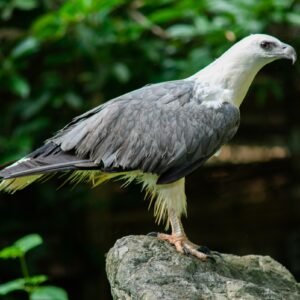
White-bellied sea eagles are large and unmistakable in flight. Adults display bright white plumage on the head, neck, breast, and belly, contrasting sharply with dark grey-brown upper wings and back. The tail is short and wedge-shaped, white on the underside. In flight, the wing profile is distinctive — broad and slightly bowed upward, with fingered primary feathers at the tips. Juveniles are streaky brown and white and take several years to achieve full adult colouration. Adults are about 75–85 cm long, with a wingspan of about 1.8 to 2 metres (up to about 2.2 m in large females). Females are slightly heavier than males.
Behaviour and Diet
White-bellied sea eagles are supremely capable hunters and opportunistic scavengers. Their primary prey in reef environments includes large fish, sea snakes, turtles (particularly hatchlings and juveniles), and water birds. They hunt by soaring above the water’s surface and plunging to snatch fish with powerful talons, or by stooping from height onto prey at or near the surface. They will also steal prey from other birds — a practice known as kleptoparasitism — and are frequently seen pursuing ospreys and other seabirds to force them to drop their catch.

Nesting and Territory
White-bellied sea eagles form permanent pairs that hold territories all year round. Pairs maintain large territories along coastlines and on islands, returning to the same nest sites year after year and adding to them over time — some nests grow to enormous proportions over successive seasons. Breeding is mainly from May to October. Usually two eggs are laid, and the female does most of the incubating. Established pairs are aggressive in defending their territories against intruding sea eagles.
Where to See Them at the Great Barrier Reef
White-bellied sea eagles are seen across the Great Barrier Reef, particularly on island groups with stable vegetation and fish-rich surrounding waters. Good places to look include Hinchinbrook Island, the Whitsunday Islands, and islands of the Capricorn and Bunker groups. They are often seen from reef tour vessels, perched on exposed island trees or soaring above coral cays during snorkelling stops. Dawn and late afternoon are peak activity periods.
A Hot Getaways destination. Where Care is Our Compass.
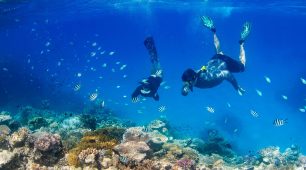
Learning about reef animals in class? We help schools, universities and study groups plan educational trips to the Great Barrier Reef. Depending on the program, groups can enjoy guided snorkelling and marine biology presentations.
Great Barrier Reef Educational Groups →
FAQs
How do you identify a white-bellied sea eagle?
How big is a white-bellied sea eagle?
Where can I see white-bellied sea eagles on the Great Barrier Reef?
What do white-bellied sea eagles eat?
How should I behave around nesting sea eagles?