
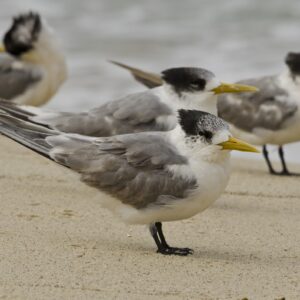
“The crested tern banks overhead in the reef wind, white and sharp against the blue sky, watching the sea below with the same patience as a navigator.”
Crested Tern of the Great Barrier Reef – Agile Seabird of the Tropical Sky
The Greater Crested Tern (Thalasseus bergii) is one of the seabirds you are most likely to see on and around the Great Barrier Reef. Elegant, highly aerial, and an accomplished plunge-diver, it’s a familiar presence on boat trips to the reef and a regular occupant of coral cay nesting colonies throughout the island system.


Quick Facts About the Crested Tern
- Common Name: Greater Crested Tern (also called Crested Tern or Swift Tern)
- Scientific Name: Thalasseus bergii
- Size: About 46–49 cm long, with a wingspan of around 1.25 metres; about 320 grams
- Diet: Small surface fish, caught by shallow plunge-dives or by dipping at the surface
- Habitat: Coasts and offshore islands right around Australia
- Breeding: Mainly October to December
- Found On The Reef: Year-round; large colonies nest on Michaelmas Cay off Cairns, mostly in summer
- Conservation Status: Least Concern (IUCN Red List)
Scientific Classification
- Kingdom: Animalia
- Phylum: Chordata
- Class: Aves (birds)
- Order: Charadriiformes
- Family: Laridae
- Genus: Thalasseus (formerly Sterna)
- Species: Thalasseus bergii
About the Crested Tern
The Greater Crested Tern is a large tern species, distinguishable by its yellow bill (often slightly greenish), shaggy black crest (outside the breeding season the forehead turns white and the rear crown is speckled black), and generally pale grey and white plumage. It is one of Australia’s largest terns (only the Caspian Tern is bigger), about 46–49 cm long with a wingspan of around 1.25 metres. The similar Lesser Crested Tern, which also nests on the Reef, has an orange bill.
They’re highly mobile birds that range widely across coastal waters and open ocean, following fish schools and using their sharp eyesight to locate prey from height before plunging into the water to catch it. Unlike some seabirds that fully submerge, terns typically perform a partial plunge and pull up quickly.
Nesting and Breeding
Greater Crested Terns nest in large colonies on sandy beaches and coral cays throughout the Great Barrier Reef. Nesting colonies can contain thousands of birds, with pairs defending minimal nest territories on the open sand or among sparse vegetation.
They’re sensitive to human disturbance during nesting season — visitors to coral cay islands are encouraged to follow ranger instructions and stay well clear of marked nesting areas.



Where to See Crested Terns
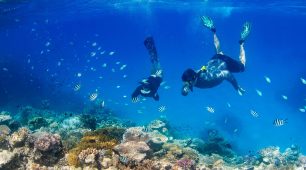
Crested Terns are present year-round in coastal Queensland and are routinely seen on reef tours, particularly when the boat is underway. They often follow vessels, scanning the wake for disturbed fish. Large colonies nest on Michaelmas Cay off Cairns, mostly in summer, and on cays in the Capricorn and Bunker groups such as the Fairfax Islands. Smaller numbers have nested on Raine Island, which is closed to visitors. Breeding is mainly from about October to December.
A Hot Getaways destination. Where Care is Our Compass.
Learning about reef animals in class? We help schools, universities and study groups plan educational trips to the Great Barrier Reef. Depending on the program, groups can enjoy guided snorkelling and marine biology presentations.
Great Barrier Reef Educational Groups →
FAQs
How do you identify a crested tern?
How big is a crested tern?
Where can I see crested terns on the Great Barrier Reef?
How do crested terns catch fish?
How should I behave around nesting terns on reef islands?