
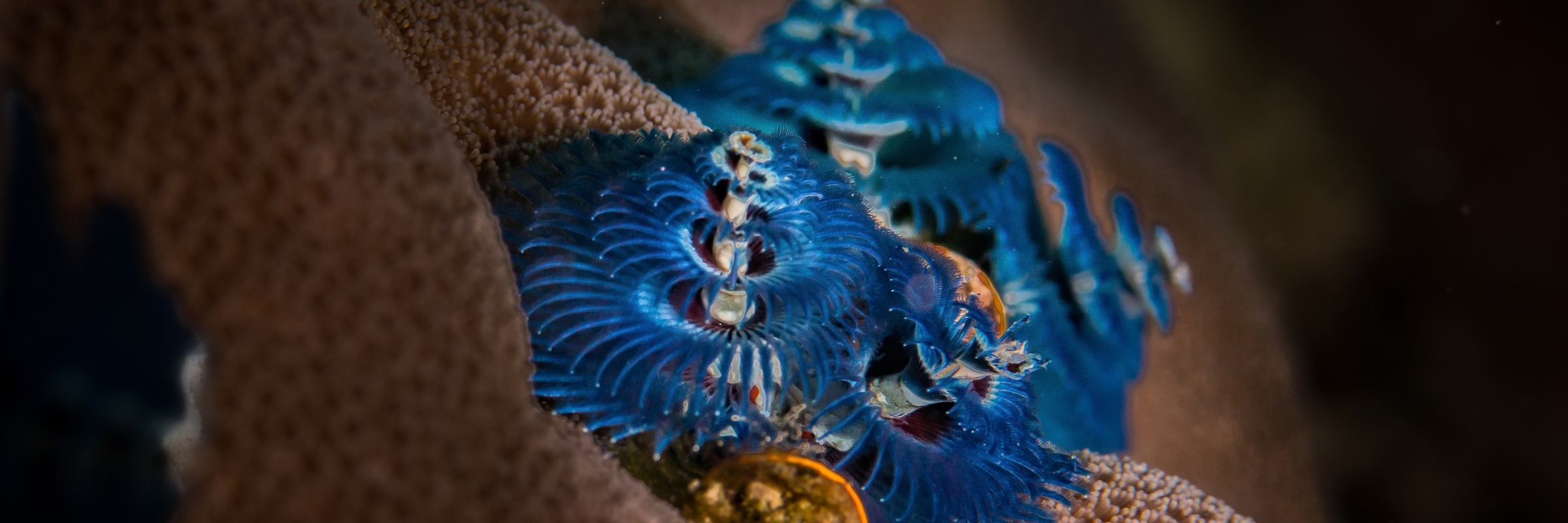
“The Christmas Tree Worm doesn’t hide — it blooms from the coral in spirals of colour, as vivid as anything you’ll see on the reef.”
Christmas Tree Worms of the Great Barrier Reef – Jewels of the Coral Architecture
Christmas Tree Worms (Spirobranchus corniculatus group) are among the most visually captivating creatures on the Great Barrier Reef. Named for the twin spirals of feathery plumes they extend from the coral surface, they come in a remarkable range of colours — white, yellow, orange, blue, purple, and combinations of all — making them a favourite with underwater photographers.


About Christmas Tree Worms
Christmas Tree Worms are polychaete tube worms that live permanently within the structure of hard corals — most often massive Porites and brain corals. Their larvae settle on living coral, and the coral then grows around the worm’s tube, so each worm stays in the same place for its whole adult life, extending its twin spirals into the water to filter plankton. The plumes also act as gills.
The distinctive twin-spiral “crowns” are their feathery radioles — used for both breathing and feeding. At the first sign of disturbance (a passing shadow, a wave, an approaching hand), they retract instantly into their tube and seal it with a hard operculum. The speed of their retraction is startling, and watching them extend back out after a short wait is one of the small, rewarding pleasures of slow reef observation.
Colours and Identification
Their colours vary enormously, and a single coral head may host dozens in different hues — creating what looks like a miniature garden of spiralling ornaments. Their diversity of colour has made them favourites among underwater photographers.


Quick Facts About Christmas Tree Worms
- Scientific name: Spirobranchus corniculatus species group (Indo-Pacific); the older name Spirobranchus giganteus is now used for the Caribbean species
- Also known as: spiral tube worm
- Found in: living hard corals on reef flats and slopes, most often massive Porites and brain corals
- Diet: plankton and fine particles filtered from the water
- Size: a small worm; the visible spiral crowns are usually only a centimetre or two across
- Best chance of sighting: snorkelling slowly over healthy Porites bommies
Scientific Classification
- Kingdom: Animalia
- Phylum: Annelida (segmented worms)
- Class: Polychaeta
- Order: Sabellida
- Family: Serpulidae
- Genus: Spirobranchus
- Species: Spirobranchus corniculatus group
- Conservation status: not assessed
Common Names
Primary: Christmas Tree Worm. Other names: Spiral Tube Worm.
Related Species
Feather duster worms (family Sabellidae) are close relatives that also live in tubes and fan out feathery crowns, but with a single crown rather than two spirals. Australian Museum research has shown that the Christmas tree worms of the Indo-Pacific are a group of closely related species rather than one.
Role on the Reef
Christmas tree worms filter tiny food from the water. Their tubes become part of the living coral, and each worm can pull back in a split second and seal its tube with a hard, spiny plug called an operculum.
Learning about reef animals in class? We help schools, universities and study groups plan educational trips to the Great Barrier Reef. Depending on the program, groups can enjoy guided snorkelling and marine biology presentations.
Great Barrier Reef Educational Groups →
Where to See Christmas Tree Worms
Christmas Tree Worms are found throughout the Great Barrier Reef wherever healthy Porites and brain corals are present. They’re common in shallow to mid-depth reef areas and are easily spotted by snorkellers and divers on most reef tours from Cairns, Port Douglas, and the Whitsundays.
A Hot Getaways destination. Where Care is Our Compass.
FAQs
What is a Christmas tree worm?
Why are they called Christmas tree worms?
What colours do Christmas tree worms come in?
Why do Christmas tree worms suddenly disappear?
How can I see Christmas tree worms without harming them?
